


As universities race to detect AI-generated work, they may be overlooking a more fundamental challenge: preparing students to use artificial intelligence responsibly. In a world where intelligent systems are increasingly embedded in learning, work, and decision-making, understanding AI may prove far more valuable than merely policing its use. The future of education lies not in surveillance and suspicion, but in cultivating AI literacy, critical judgement, transparency, and intellectual ownership.
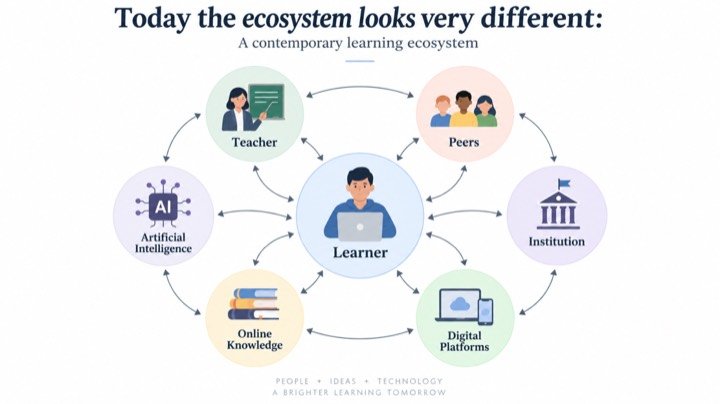
The advent of generative artificial intelligence has revealed a profound tension in the contemporary education ecosystem. While AI systems are rapidly being integrated into workplaces, research environments, and everyday decision-making, many educational institutions remain preoccupied with a different challenge: identifying which assignments were written with AI assistance. Across universities and schools, considerable resources are being invested in AI detection software, academic integrity policies, and mechanisms to identify potential misuse. Yet this response may be addressing the symptom rather than the cause. The more pressing educational question is not whether students are using AI, but whether they understand it well enough to use it responsibly. What is more intriguing here is that two brain systems are constantly vying for supremacy, and, on average, we are losing out in terms of adaptability, accuracy, and agility to the intelligent machine ecosystem. Nobel laureate Prof. Geoffrey Hinton, also known as the father figure of AI, once said in an interview, “How many examples do you know of a more intelligent thing being controlled by a less intelligent thing?” His assertion (not a question, though) clearly explains the looming threat over the less intelligent group, and, needless to say, if we do not become AI-literate, the more intelligent systems will eventually prevail.
Historically, education has often reacted cautiously to technological disruption. Calculators were once seen as threats to mathematical thinking. Search engines were criticised for weakening memory. Wikipedia was viewed with suspicion because knowledge could be accessed instantly rather than painstakingly gathered from traditional sources. Over time, however, these technologies were accepted not because they were flawless, but because society learned that educational value lies in understanding and application rather than mere access. Generative AI poses a similar challenge, albeit on a much larger scale. Unlike previous tools, AI does not simply retrieve information; it generates text, ideas, images, code, and analyses that often resemble human work.
This zero-prior data manipulation capability has understandably unsettled educators. If a machine can draft an essay in seconds, what becomes of learning? The answer, however, may not lie in surveillance. AI detection systems rely on probabilistic pattern recognition. They do not know whether a student cheated. They identify linguistic features that statistically resemble machine-generated outputs. As researchers have repeatedly shown, these systems produce both false positives and false negatives. Fluent writers, multilingual learners, and even entirely original human-authored texts can be incorrectly flagged. In such circumstances, the confidence placed in detection technologies often exceeds their actual reliability. Consider a non-native speaker who, through sustained effort, practice, and exposure, develops writing skills that suddenly appear polished, coherent, and sophisticated. Such work may still be flagged by AI detection tools, despite being entirely human-authored. This highlights a fundamental limitation of AI detectors: they identify statistical patterns and linguistic regularities rather than definitive evidence of authorship. At best, these systems generate suspicion; they do not establish proof. Their conclusions are based on pattern-recognition algorithms that infer probabilities from textual characteristics, not on direct access to the writer’s cognitive processes. Consequently, while AI detectors may serve as preliminary indicators warranting further inquiry, they are rarely sufficient to conclusively determine whether a piece of work is AI-generated. What they often detect is not authorship itself, but deviation from expected writing patterns—an outcome that can just as easily reflect genuine learning and improvement as artificial assistance.
Recognising these limitations, the Kelley School of Business at Indiana University recently prohibited faculty from using AI detection software as evidence of academic misconduct. The decision reflects a growing recognition that the educational value of detection may be considerably lower than many institutions assume. Rather than focusing on identifying AI-generated content, the emphasis is shifting towards designing assessments that require students to demonstrate understanding, justify decisions, explain their reasoning, and apply concepts in unfamiliar situations. Such approaches place learning back at the centre of education rather than turning assessment into a technological arms race.
The debate reveals a deeper misunderstanding of the nature of intelligence. Education has never been solely about producing answers. Its purpose has been to cultivate judgment, reasoning, interpretation, and the ability to navigate uncertainty. A student who genuinely understands a concept can defend it, critique it, connect it to broader ideas, and apply it in novel contexts. Conversely, a student who merely copies an AI-generated response often struggles to explain underlying assumptions or respond to probing questions. In this sense, thoughtful assessment has always been the most effective detector of genuine understanding, rather than sophisticated software.
The challenge becomes even more significant when viewed from the perspective of future employability. Graduates entering contemporary organisations will encounter AI-enhanced environments across finance, healthcare, education, marketing, governance, engineering, and research. Employers increasingly seek individuals who can collaborate with intelligent systems while maintaining critical oversight. The competitive advantage will belong not to those who avoid AI entirely, but to those who can evaluate its outputs, identify errors, recognise biases, and make informed decisions. Educational institutions that focus exclusively on restricting AI use risk preparing students for a world that no longer exists.
This is exactly where AI literacy becomes critically important. AI literacy goes far beyond learning to write prompts. It encompasses understanding how algorithms work, recognising the limitations of machine learning models, identifying hallucinations, evaluating evidence, questioning automated recommendations, protecting privacy, and maintaining human agency in decision-making. At its core, AI literacy is about cultivating informed scepticism alongside technological competence. It teaches learners not only how to use AI but also when not to trust it.
India’s evolving response to artificial intelligence increasingly reflects this perspective. National initiatives under the IndiaAI Mission, along with programmes such as YUVA AI for All and AI readiness campaigns in schools, signal a growing recognition that AI literacy must become a foundational educational competency. These efforts acknowledge a reality that many institutions are only beginning to confront: artificial intelligence is not a specialised technology reserved for computer scientists. It is rapidly becoming a general-purpose technology that will influence virtually every profession and discipline.
The implications for education are profound. Universities may need to rethink assessment design, classroom practices, and definitions of academic integrity. Rather than treating every interaction with AI as a potential violation, educators may need to focus on transparency, accountability, and critical engagement. Students should be encouraged to disclose how AI was used, reflect on its contributions, and demonstrate ownership of their intellectual work. This approach mirrors professional realities, where responsible use of AI is increasingly valued over complete avoidance.
The future of education is unlikely to be secured by better detection systems. As AI models continue to evolve, distinguishing between human-generated and AI-assisted work will become increasingly difficult, perhaps even irrelevant. What will remain relevant is whether learners possess the judgement to navigate a world saturated with intelligent technologies. The institutions that succeed will not be those that become better at catching students. They will be those who become better at teaching them.
The question for educators, policymakers, and institutions is therefore not whether artificial intelligence belongs in education. That question has already been answered by reality. The more pressing question is whether education will equip learners with the literacy to use these technologies wisely, ethically, and critically. In the long run, societies are unlikely to be defined by how effectively they detect AI use. They will be defined by how effectively they prepare people to live, learn, and lead in an AI-enabled world.
Note: In case you wish to explore further, you may refer to my book titled ‘Many Minds, One Nation: Diversity of Intelligence, Unity of Purpose,’ available at https://www.amazon.com.au/Many-Minds-One-Nation-Intelligence/dp/B0H1VHLCSC
Looking forward to reading your comments or observations.