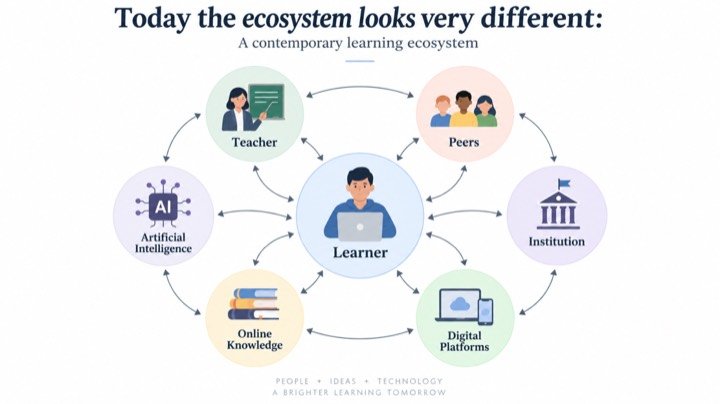





As classrooms become increasingly digitised, a silent shift is underway: students are performing more but understanding less. The teaching – learning ecosystem is experiencing the change of guard where cognitive offloading and the proliferation of “digital plastic” are reshaping learning, raising urgent questions about depth, thinking, and the future of meaningful education in a technology-driven academic world.
There was a time when education was perceived as much about becoming as it was about knowing. Today, in classrooms increasingly mediated by screens, algorithms, and artificial intelligence, that balance seems to be shifting. Students are performing—often impressively—on measurable indicators, such as test scores of written and verbal examinations, assignment completion rates, and rapid information retrieval through articulation. Yet, beneath this quantitative shine lies a quieter concern: are we witnessing the slow erosion of qualitative learning? At the heart of this change is a phenomenon called cognitive offloading—the delegation of thinking, memory, and problem-solving to digital tools. What was once a helpful aid has now grown into a widespread educational habit. In this new landscape, I suggest a metaphor: “digital plastic”—ubiquitous, convenient, and efficient, yet potentially polluting the cognitive ecosystem of learning.
As T.S. Eliot once warned in his play The Rock (1934), “Where is the wisdom we have lost in knowledge? / Where is the knowledge we have lost in information?” Today, we might extend his lament: where is the knowledge we have lost in information—and the thinking we have outsourced to machines?
Cognitive Offloading Paradigm
Cognitive offloading is not a new concept. Humans have always externalised cognition—from writing and printing to calculators and computers. However, the scale, immediacy, and intimacy of today’s digital tools mark a significant change. Smartphones, search engines, and generative AI systems now serve as continuous cognitive extensions, always within reach. Recent research highlights the complexity of this phenomenon. A 2026 study in Frontiers in Psychology finds that cognitive offloading can improve learning outcomes—but only when mediated by cognitive self-efficacy, or the learner’s belief in their own thinking ability. In other words, digital tools can support learning—but they should not replace the learner’s cognitive agency. Yet, the reality in many classrooms suggests otherwise. Students increasingly rely on digital tools not as scaffolds but as substitutes.
Emergence of “Digital Plastic”
Plastic, in its material form, revolutionised modern life—lightweight, flexible, and durable. But its very durability has turned it into a global pollutant. Likewise, digital plastic refers to the buildup of low-effort, high-speed cognitive interactions that replace more profound intellectual engagement. The term was coined by Leon Furze last year in his co-authored research paper titled “Digital plastic: a metaphorical framework for Critical AI Literacy in the multiliteracies era”.
Students increasingly take screenshots instead of taking their own notes, search for information rather than trying to recall it, depend on AI prompts instead of building arguments independently, and skim through material rather than engaging in sustained reading. While each of these practices may seem efficient and even necessary in a fast-paced digital environment, their cumulative effect is more concerning. Note-taking, for example, is not just a recording activity but a cognitive process involving selection, organisation, and interpretation; replacing it with screenshots bypasses this mental engagement. Similarly, recalling information strengthens memory pathways, while habitual searching weakens this internal retrieval system. Relying on AI-generated responses can further displace the effortful process of constructing arguments, limiting opportunities for critical thinking and original synthesis. Skimming also reduces exposure to complexity, nuance, and layered meaning within texts. These practices are not inherently harmful on their own; however, when they become habitual, they create what can be called a cognitive residue—a layer of superficial engagement that gradually hinders deeper processing, weakens conceptual understanding, and ultimately undermines meaningful learning. A large-scale review of over 500 studies published in 2026 titled “A Review of the Negative Effects of Digital Technology on Cognition” suggests that excessive reliance on digital tools may lead to an “efficiency-atrophy paradox”—where short-term performance improves, but long-term cognitive capacity declines. This paradox is central to the concept of digital plastic: efficiency that accumulates into impairment.
Quantitative Gains, Qualitative Losses
One of the most striking features of contemporary education is the divergence between quantitative performance and qualitative understanding.
Students today:
- Complete more assignments
- Access more information
- Produce more content
Yet, educators increasingly report:
- Reduced critical thinking
- Lower conceptual clarity
- Weak transfer of knowledge to new contexts
Emerging evidence supports this concern. Studies on AI-assisted learning, like “Why Johnny Can’t Think: GenAI’s Impacts on Cognitive Engagement” and “ChatGPT produces more ‘lazy’ thinkers: Evidence of cognitive engagement decline”, indicate that frequent reliance on such tools is linked to reduced cognitive engagement, including less reflection and critical thinking. Another experimental study found that students using AI tools exhibited significantly lower levels of deep cognitive processing than those working independently. This is not a failure of students—but of the learning environment in which they are embedded.
Neurological Implications: Use It or Lose It
Learning is fundamentally a neurological process. Repetition, effort, and struggle strengthen neural pathways. When students engage deeply with material—grappling with concepts, making connections, solving problems—they are effectively rewiring their brains. Cognitive offloading interrupts this process. When tasks are delegated to digital tools: