


Quantum Teaching provides a practical and human approach to education, grounded in research and real classroom experiences. It highlights the brain’s learning processes and the impact of emotions on understanding, aligning with NEP 2020’s vision of holistic, learner-centred education. Instead of solely focusing on exam performance, it fosters confidence, curiosity, and adaptability for life beyond school.
Why Teaching Must Change Now
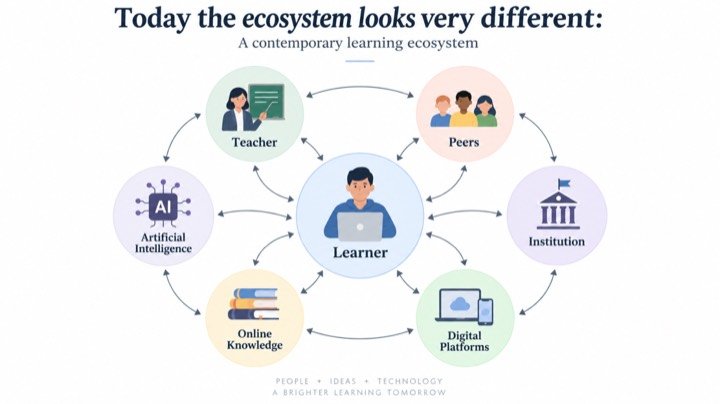
The continuously evolving landscape of knowledge construction and transmission warrants two important facets – relevance and interconnectedness. Imparting education worldwide is experiencing significant and positive change. Rapid technological advances, shifting workforce needs, globalization, and increasing social complexity are prompting educators to reconsider not just what we teach but how we teach it. In India, the New Education Policy (NEP) 2020 represents a historic milestone in this evolution. It advocates a shift away from rote learning towards holistic, experiential, competency-based, and learner-centric education at all levels—from schools to universities. Over the last few years, the emphasis and structural reforms have increased with the noble intention to replace rigid syllabi-based learning with skill & competency-based learning to infuse a more skilled workforce in the economy.
Within this changing environment, Quantum Teaching emerges as a powerful and timely teaching method. Based on brain-based learning, positive psychology, and experiential pedagogy, Quantum Teaching naturally aligns with the vision and spirit of NEP 2020. It provides teachers with a practical yet human-centred framework to create joyful, meaningful, and future-ready learning experiences.
Till yesterday the academia was associating quantum concepts with Physics or electronics. However, the simple meaning of quantum is very small energy. packets. Therefore, the concept of adding quantum philosophies to teaching indicates that we may need to energise our pedagogic style and practices to exalt joy, happiness, and gainful learning. The concept of Quantum Teaching is gaining popularity as a practical and effective approach for school and university educators. By drawing from established quantum learning principles and integrating them within the framework of NEP 2020, let’s examine how Quantum Teaching can influence the future of Indian education.
Understanding Quantum Teaching: Beyond Methods to Mindsets
Quantum Teaching is not a collection of isolated teaching techniques; it is a comprehensive philosophy of learning. The term “quantum” signifies amplification of learning gain through interaction. Just as subatomic particles influence one another in dynamic ways, teaching and learning are viewed as interactive processes where environment, emotions, cognition, relationships, and experiences interact to create powerful outcomes.
Originally developed by the President of Quantum Learning Network (QLN), Roberta ‘Bobbi’ DePorter and colleagues, Quantum Teaching integrates research from neuroscience, cognitive psychology, accelerated learning, and constructivist pedagogy. Its central belief is simple yet profound: learning improves dramatically when teachers deliberately design environments and experiences that engage the whole learner—mind, body, and emotions.
In contrast to traditional teacher-centric instructional pedagogy, Quantum Teaching:
- Treats students as active participants in meaning-making
- Values emotions as essential to cognition
- Emphasizes experience before explanation
- Recognizes effort, growth, and celebration as central to learning
These principles resonate strongly with NEP 2020’s call for joyful, inclusive, and multidisciplinary learning.
Core Principles of Quantum Teaching
Quantum Teaching is guided by a set of foundational principles that shape classroom practice across contexts and age groups.
1. Everything Speaks
Every element of the learning environment communicates a message. Classroom layout, teacher language, assessment practices, and even moments of silence influence how learners perceive themselves and the subject. This principle encourages teachers to become intentional designers of meaning rather than passive managers of content.
2. Everything Is on Purpose
Teaching decisions are deliberate and aligned with learning outcomes. Lessons, activities, and assessments are planned with clarity of intent, reflecting the outcome-based and competency-focused orientation promoted by NEP 2020.
3. Experience Before Label
Students learn best when they encounter ideas through concrete experiences before encountering formal terminology or abstract theory. This principle reflects constructivist learning and underpins experiential, inquiry-based, and project-based approaches promoted by NEP 2020.
4. Acknowledge Every Effort
Effort fuels growth. By recognizing attempts, persistence, and improvement, teachers cultivate a growth mindset and reduce fear of failure—both essential for creativity and innovation.
5. If It’s Worth Learning, It’s Worth Celebrating
Celebration strengthens memory and motivation. When learning is associated with positive emotion, it becomes enduring and transferable.
NEP 2020 and the Pedagogical Shift
The National Education Policy 2020 calls for nothing less than a paradigm shift in Indian education. Some of its key pedagogical directions include:
- Learner-centric and competency-based education
- Experiential, inquiry-driven, and discussion-based learning
- Integration of cognitive, social, emotional, and ethical development
- Reduction of content overload
- Emphasis on critical thinking, creativity, and problem-solving
- Continuous formative assessment
Quantum Teaching offers a ready-made pedagogical bridge to translate these policy aspirations into daily classroom practice.
Quantum Teaching and Experiential Learning under NEP 2020
One of the strongest points of convergence between Quantum Teaching and NEP 2020 is experiential learning. NEP emphasizes learning through doing, reflecting, and applying knowledge in real-life contexts.
Quantum Teaching operationalizes this through its well-known learning design framework:
Enroll – Experience – Label – Demonstrate – Review – Celebrate
This sequence ensures that learning is emotionally engaging, cognitively meaningful, and socially reinforced.
- Enroll captures attention and answers the learner’s question: Why should I learn this?
- Experience immerses students in shared activities or problems
- Label introduces concepts, vocabulary, and theory
- Demonstrate allows learners to apply and show understanding
- Review consolidates learning
- Celebrate acknowledges achievement and growth
This cycle is equally effective in a Class VIII classroom or a postgraduate university seminar.
Multidisciplinary and Holistic Learning
NEP 2020 strongly advocates multidisciplinary education, breaking down rigid subject silos. Quantum Teaching naturally supports this integration.
For example:
- A lesson on climate change can integrate science, economics, ethics, and communication skills
- A literature class can incorporate psychology, history, and social analysis
- An engineering course can integrate teamwork, ethics, and design thinking
Quantum Teaching encourages such integration by focusing on connections, patterns, and meaning rather than isolated facts.
Social-Emotional Learning and Well-being
NEP 2020 recognizes that student well-being is foundational to academic success. Quantum Teaching places emotions at the centre of learning.
Research shows that positive emotional states enhance memory, creativity, and problem-solving. Quantum classrooms, therefore emphasize:
- Psychological safety
- Respectful dialogue
- Teacher-student rapport
- Peer collaboration
- Recognition and celebration
These practices contribute to emotionally resilient learners—an explicit goal of NEP 2020.
Quantum Teaching in School Education
In school contexts, Quantum Teaching can transform classrooms into vibrant learning communities.
Key Applications:
- Storytelling and role-play for concept formation
- Movement-based activities for kinaesthetic engagement
- Visual organizers and mind maps
- Cooperative learning structures
- Reflective journals and portfolios
Teachers become facilitators, designers, and mentors rather than mere transmitters of content. Students become confident learners who ask questions, take risks, and learn from mistakes.
Quantum Teaching in Higher Education
Universities and colleges face unique challenges—large classrooms, diverse learners, and abstract content. Quantum Teaching is equally relevant here.
Applications in Higher Education:
- Case-based and problem-based learning
- Seminar discussions and peer teaching
- Research projects and inquiry-based assignments
- Flipped classrooms
- Authentic assessment through presentations, portfolios, and projects
Quantum Teaching humanizes higher education by restoring dialogue, curiosity, and intellectual joy.
Assessment Reimagined: From Testing to Learning
NEP 2020 advocates assessment for learning rather than assessment of learning. Quantum Teaching supports this through continuous formative assessment.
Key features include:
- Frequent feedback
- Self-assessment and peer assessment
- Reflection and goal setting
- Portfolio-based evaluation
Assessment becomes a learning tool rather than a source of anxiety.
Technology, Quantum Teaching, and the Future
Technology, when thoughtfully integrated, can enhance Quantum Teaching. Digital tools support:
- Interactive simulations
- Virtual labs and field experiences
- Collaborative projects across institutions
- Digital portfolios
- Personalized feedback
However, Quantum Teaching reminds us that technology must serve pedagogy, not replace human connection.
Teacher Professional Development and NEP 2020
NEP 2020 emphasizes continuous professional development for teachers. Quantum Teaching provides a strong framework for Faculty Development Programmes (FDPs), focusing on:
- Reflective practice
- Brain-based pedagogy
- Classroom design
- Assessment literacy
- Teacher well-being
When teachers experience Quantum Teaching as learners, they are more likely to implement it authentically.
Challenges and the Way Forward
Implementing Quantum Teaching requires:
- Time for planning
- Institutional support
- Professional learning communities
- Gradual, reflective adoption
The future of NEP 2020 depends not only on policy documents but on empowered teachers who can translate vision into practice.
Quantum Teaching as the Pedagogy of the Future
As India advances toward the ambitious goals of the National Education Policy (NEP) 2020, effective pedagogy plays a crucial role in driving impactful educational reform. Quantum Teaching, which is research-based, human-centred, and future-oriented, aligns perfectly with the policy’s emphasis on holistic growth, flexibility, and learner empowerment. By honouring neurobiology, leveraging emotional engagement, and respecting student dignity, Quantum Teaching prepares learners not only for exams but also for life beyond the classroom.
An example of this teaching philosophy in action is Jammu University’s “Design Your Degree” program. This initiative embodies NEP 2020’s goals of interdisciplinary learning, academic choice, and personalized educational pathways. Such models illustrate a future where students actively shape their educational journeys by integrating knowledge, skills, and values. The four-year degree program is thoughtfully designed to help students acquire social skills such as value-based learning, numerical abilities, language proficiency, and various interdisciplinary courses in the first two years. In the final two years, students can choose specialization courses that ultimately determine the title of their degree. This innovative approach not only allows students to select a program that aligns with their interests and abilities but also prepares them to be future-ready.