
Continuity in teaching does not equate to continuity in learning. In an era of blended education driven by AI and disruption, students can remain engaged and submit quality work without genuine comprehension. Learning continuity refers to the ability to maintain, adapt, and expand knowledge despite shifts in teachers, technology, or circumstances. While AI can serve as a supportive scaffold for learning, overreliance on it might hinder critical thinking. The article emphasises that education systems need to prioritise developing capabilities, adaptability, reflection, and independent judgement.
Keywords: Learning Continuity; Artificial Intelligence; Higher Education; Learner Agency; Cognitive Offloading
Introduction
For generations, we have associated education with a familiar picture: a teacher, a classroom, a timetable, books, examinations, and students moving from one academic year to another. When these arrangements run smoothly, we assume that learning continues. If classes are held, attendance is recorded, assignments are submitted, and examinations are completed, the educational system appears to be doing its job.Now, the all-important question is: Does teaching continuity mean the same as learning continuity?
The question became impossible to ignore during the COVID-19 pandemic. Overnight, classrooms closed, teachers moved online, examinations were redesigned, and students began learning through screens. Institutions worldwide worked extraordinarily hard to ensure what was commonly called “continuity of education”. Yet the experience revealed something more fundamental. A university could successfully migrate classes online and still leave some students confused, isolated, or unable to apply what they had supposedly learned. At the same time, another student might miss several physical classes but retain sufficient understanding, motivation, and access to resources to continue learning independently. The distinction is simple yet profound: continuity of teaching is not necessarily continuity of learning. This distinction has become even more important in the age of artificial intelligence.
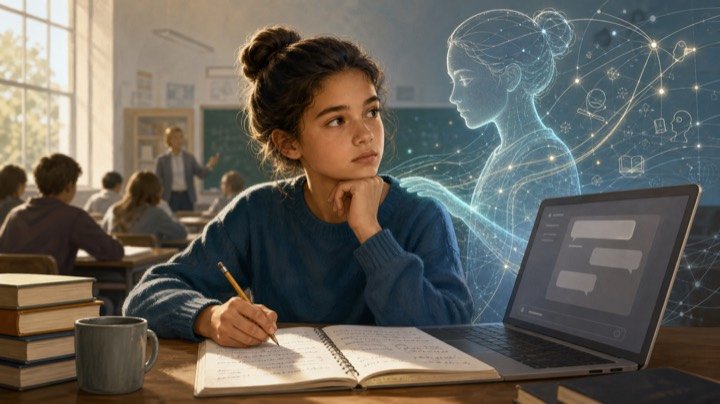
A student can now ask a generative AI system to explain a difficult concept, summarise a chapter, solve a mathematical problem, prepare a presentation, analyse data, draft an essay, or even challenge an argument. Used wisely, these systems can become extraordinarily powerful learning companions, but they can also make it increasingly difficult to tell whether the quality of an output reflects the learner’s capability or the machine’s. The future of education may therefore depend less on whether students use AI and more on whether they can continue to think, judge, retrieve, apply and learn when AI assistance changes or becomes unavailable.
From Attendance to Capability
Educational institutions have traditionally relied on visible indicators because they are easy to measure. Attendance can be counted, credits accumulated, assignments graded, and degrees awarded.
Learning itself is less visible.
A student may score well in an examination by memorising information, only to forget most of it within weeks. Another may initially struggle with a problem but eventually develop an understanding they can apply years later in an unfamiliar setting. Which student has learned more?
Psychological research has long warned us against conflating immediate performance with durable learning. Cognitive psychologists Henry Roediger and Jeffry Karpicke’s influential 2006 work on retrieval practice showed that actively recalling knowledge yields stronger long-term retention than repeatedly studying the same material. Robert and Elizabeth Bjork similarly showed that some learning conditions that seem difficult in the short term can create what they call “desirable difficulties”, thereby strengthening later retention and transfer.
Education therefore needs a longer time horizon. The important question is not only: Can the learner perform today? It is also: Can the learner retrieve, reconstruct and apply this knowledge tomorrow, in another course, another workplace, or another problem? This idea lies at the heart of what I have been developing through the concept of Learning Continuity.
In earlier work, Learning Continuity was distinguished from the simple continuation of classes and from “contiguity”, a much older behaviourist concept associated with E. R. Guthrie. In a recent theoretical paper, Mukherjee and Islam (2026) positioned Learning Continuity as a response to fragmented learning pathways, drawing connections among major theories of learning. Complementary empirical work by Chakraborty, Mukherjee, Jena and Islam (2026) developed the D&S Learning Continuity Scale to monitor learner progression in technology-mediated higher education. The central idea is straightforward: learning should be assessed as a trajectory, not merely as a sequence of events.
Learning Must Survive Change
A truly continuous learner should be able to adapt to changes in the conditions of learning. Teachers may change. Courses may change. Physical classes may be interrupted. Technology may change. A student may move from university to employment or from face-to-face teaching to blended learning. New tools may emerge. Artificial intelligence itself will evolve rapidly. Learning Continuity asks whether the learner retains the capacity to move forward despite such changes.
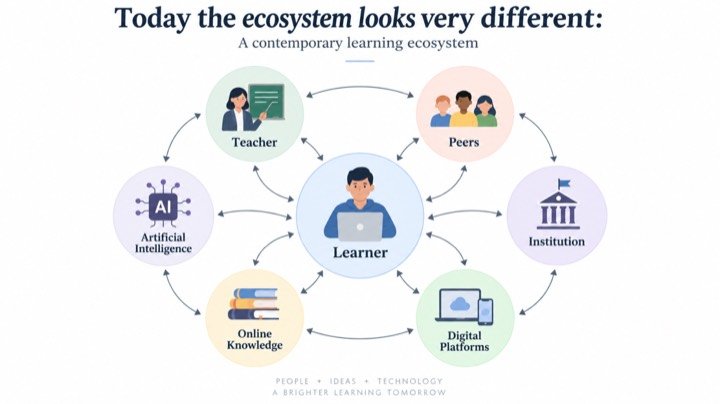
John Dewey came close to this idea nearly ninety years ago in Experience and Education. He argued that every experience grows out of previous ones and influences those that follow. Education, in other words, is developmental. Learning should broaden the possibilities for future learning. The contemporary problem is that the number of actors influencing that development has increased dramatically. Previously, we could roughly describe formal learning in terms of the relationship among the learner, teacher and institution.
The learner is surrounded by more knowledge than ever before. Yet access to knowledge does not automatically produce understanding.
The Promise and Danger of AI
Recent research illustrates this tension vividly. In one study, students given powerful generative AI assistance performed much better while the technology was available, but some of that advantage disappeared when assistance was withdrawn. In contrast, another recent randomised controlled trial by theoretical physicist Greg Kestin and colleagues (2025) found that a carefully designed AI tutor produced substantial learning gains in an undergraduate physics setting.
These findings are not contradictory. They tell us that asking whether “AI is good or bad for education” is the wrong question. A calculator can save time without undermining mathematical reasoning when the learner understands what is being calculated. Similarly, AI can free students from low-value routine work, enabling them to focus on interpretation, creativity, comparison and judgement.
To our dismay, trouble begins when the machine performs the very mental activity the learner needs to develop.
Psychologists Evan Risko and Sam Gilbert in 2016 described the broader phenomenon as cognitive offloading: humans routinely move cognitive work into the environment. We write reminders because we do not want to remember everything. We use calculators, maps, search engines and notebooks. This is neither new nor inherently harmful. Generative AI, however, represents a qualitative change. We can now offload not merely memory or calculation, but explanation, synthesis, reasoning, argumentation and even decision-making. This creates an educational paradox. A student may become more productive while becoming less capable. The assignment improves, but the learner does not.
The Need for Bounded Cognitive Offloading
The challenge, therefore, is not to eliminate cognitive offloading but to bound it intelligently. Students should be allowed to use AI where it expands their capacity without replacing the intellectual processes they need to retain. Consider a student learning statistics. Using AI to generate additional practice problems may strengthen learning. Asking AI to explain why an answer is wrong may also help. Comparing two competing explanations generated by AI can deepen judgement. But asking AI to solve every problem before attempting it may weaken the student’s ability to recognise the appropriate method.
The same principle applies in professional education.
A medical student may legitimately use AI to compare possible diagnoses, but the student must still recognise a deteriorating patient, question an implausible recommendation, and act when technology is unavailable. An employee using AI for data analysis need not manually perform every repetitive calculation. But that employee should understand the assumptions behind the analysis and be able to identify an impossible conclusion. Education in the AI age must therefore develop dual capability: the ability to work effectively with intelligent tools and the ability to retain sufficient independent knowledge to supervise, verify, and recover when those tools fail.
Learners Are Not Fixed Types
Another important principle of Learning Continuity is that learners should not be permanently labelled. The Learner Matrix, derived from earlier research, identifies four positions: Induced, Rote, Traditional and Matured. These should not be treated as personality types. A person may display mature learning behaviour in one domain and rote learning in another. A professor of economics learning a new programming language may temporarily rely on step-by-step guidance. A student who initially needs close supervision may later design an independent learning pathway.
The real educational question is about movement. Is the learner becoming increasingly able to understand, connect, question and transfer knowledge? Or does the learner remain permanently dependent on external prompting? This question becomes critical with AI because technology can either help a learner move towards maturity or freeze dependence at an invisible level. A good AI tutor should gradually make itself less necessary.