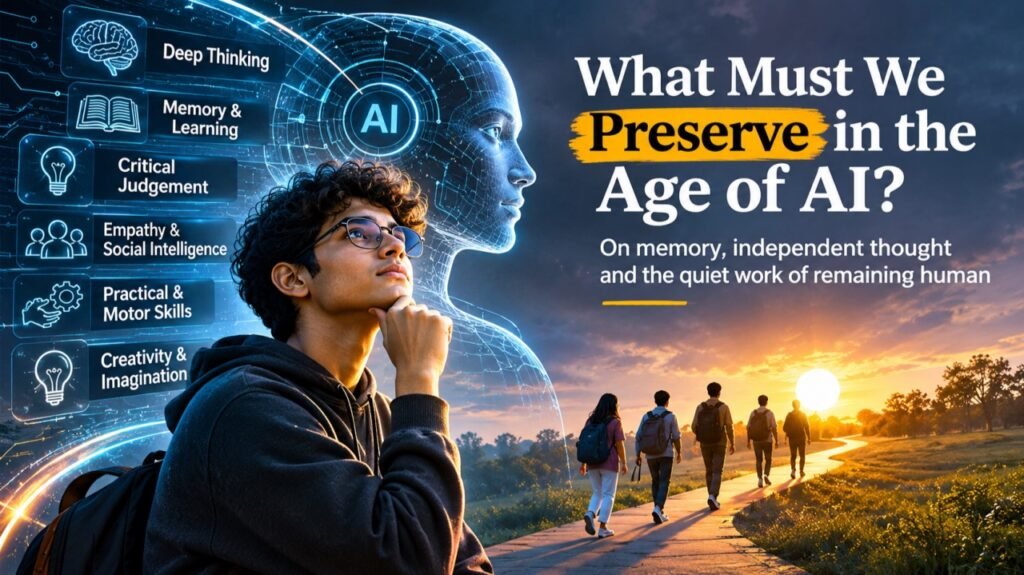



As artificial intelligence increasingly assumes tasks once requiring human intellect, an important question emerges: what must humanity preserve? Beyond technological competence, future generations must safeguard memory, critical thinking, independent judgement, creativity, social intelligence and practical skills. Drawing upon the perspectives of prominent thinkers and cognitive scientists, this article examines how excessive technological dependence may weaken intellectual autonomy and meaningful human engagement. It advocates cognitive self-preservation—the conscious cultivation of human capabilities despite growing reliance on intelligent machines. The central argument is that genuine progress lies not merely in developing smarter technologies, but in preserving our capacity to think independently.
Part two of a series. This essay follows Does AI Learn While We Sleep? Why Context Engineering Matters More Than the Dream Metaphor.
Let’s begin with a familiar story. As winter approaches, it is examination season in academic institutions, a difficult time for students who must grapple with content, clarity, and cognition across subjects, all at once. Missed assignments or presentations pose another challenge to securing good grades. Overwhelmed by these challenges, a young student asks an AI assistant to summarise a chapter, draft an argument, and prepare questions for a class presentation to make up for the missed opportunity. The answers arrive almost instantly. The presentation goes well. But a few days later, when asked to explain the central idea without the screen, the student struggles. What exactly has been learned: the subject or the art of obtaining an answer? Sounds familiar enough?
Well, this is not an argument against artificial intelligence, nor is it intended to demonise the use of AI. It is a question about what convenience can quietly displace. We celebrate what AI enables us to produce, but pay less attention to the capacities we no longer need to exercise. Our challenge is not merely to become fluent users of intelligent machines. It is to preserve the intelligence, judgement, memory, imagination and social understanding that make their assistance meaningful.
The conversation extends beyond any single thinker. Nicholas Carr warned about the cost of distracted, fragmented reading long before generative AI (Carr, 2008). Maryanne Wolf later explored what a digital reading culture might mean for deep comprehension and reflection (Wolf, 2018). Sherry Turkle has argued for the irreplaceable value of human conversation (Turkle, 2015). Alvin Toffler foresaw education centred on the ability to learn, unlearn and relearn (Toffler, 1970). Yuval Noah Harari urges young people to develop intellectual, social and practical capabilities amid uncertainty (Harari, 2018). Their concerns differ, yet together they invite a more consequential question: what must we refuse to lose?
The Ability to Stay with a Difficult Thought
Perhaps the first thing we must preserve is the willingness to think before seeking an answer. Carr’s concern was never simply the number of hours spent online; it was what a culture of speed and interruption might do to sustained attention. Wolf similarly reminds us that deep reading is not an automatic human reflex. It is an acquired capability, strengthened by repeated practice, that helps us connect ideas, examine assumptions, and consider another person’s perspective (Carr, 2008; Wolf, 2018).
AI can make difficult material accessible, simplify unfamiliar concepts, and open doors that once remained closed. But if every demanding paragraph is reduced to a summary and every intellectual obstacle is removed before we engage with it, the learner may become fluent in short explanations without developing the patience that complex problems require. Cognitive load is real; overwhelming people does not improve learning (Sweller, 1988). Yet removing all productive effort is not the answer either.
We should therefore protect uninterrupted reading, slow writing, thoughtful argument, and the experience of not knowing immediately. A student might first attempt a problem, consult AI for criticism or alternatives, and then explain the conclusion independently. Such a sequence uses technology to extend thought rather than bypass it.
The Memory that Allows Understanding
Memory has become unfashionable in an age when almost everything seems retrievable. Why remember a theory, historical event or mathematical principle when a machine can reproduce it instantly? Because understanding is not assembled from disconnected facts at the moment we need it. It grows through relationships among ideas already held in the mind.
Sparrow, Liu and Wegner (2011) found that expectations of future access to information can shape what people remember. Their work focused on digital search, not today’s generative AI, but the question has become sharper: when a machine can also explain and synthesise information, what knowledge do we still make our own? Cognitive offloading—the use of external aids to reduce mental demands—is often useful and sometimes necessary (Risko & Gilbert, 2016). The danger is not offloading itself; it is losing the ability to decide what should not be offloaded.
Foundational knowledge, personal experience, and the intellectual vocabulary needed for judgement deserve a place in our memory. There are practical ways to nurture them. Close the screen and reconstruct what you read. Explain an argument to someone else. Revisit important ideas over time. Research on retrieval practice shows that the effort of recalling information supports durable learning (Roediger & Karpicke, 2006). We need not memorise everything. We must remember enough to think for ourselves.
Judgement that Cannot be Delegated
A convincing response is not necessarily correct, and a correct response is not always wise. AI can weigh possibilities, but the human user still needs to ask whose interests are being served, what evidence is missing, and what consequences may follow. The more smoothly a system speaks, the easier it becomes to mistake verbal confidence for reliability.
A 2025 study of 319 knowledge workers found that greater confidence in generative AI was linked to lower self-reported engagement in critical thinking, whereas confidence in one’s own ability showed the opposite pattern (Lee et al., 2025). This does not prove that AI causes cognitive decline. It does, however, underline the importance of how we engage with these tools. The issue is not whether to use AI, but whether the responsibility to verify, interpret and decide remains with us.
I would call this responsibility cognitive self-preservation: the deliberate effort to retain independent intellectual functioning even when external intelligence is readily available. It means retaining the ability to frame a question, challenge a plausible answer, recognise uncertainty and make a defensible decision. It is more than AI literacy. It is an enduring commitment to remain an active thinker rather than an approving spectator.
The Human Conversation, and the Human Hand
We must also protect abilities that cannot be reduced to information processing. Turkle’s work reminds us that conversation involves listening, hesitation, disagreement, affection and responsibility—not merely the exchange of agreeable sentences (Turkle, 2015). AI companions and tutors may offer welcome support, but a simulated sympathetic response is not the same as a relationship in which two people owe one another honesty and care. Empathy develops through encounters with real difference. Our young people need communities, friendships, teamwork and opportunities to resolve disagreements without an algorithm smoothing every edge.
Equally, practical competence matters. An AI-generated diagram of an experiment does not replace handling the apparatus; a tutorial on music does not replace the fingers learning an instrument. What we loosely call “muscle memory” is rooted in repeated motor practice and nervous-system learning. Machines can assist with physical work, but skill must still be exercised to be acquired and maintained. Schools and universities should not quietly trade laboratories, studios, sport, fieldwork and practical creation for an endless sequence of screen-based demonstrations.
Harari’s memorable emphasis on head, heart and hands is useful here, but it becomes meaningful only when translated into daily experience. Thinking, relating and doing must remain integral to education, not decorative additions to digital proficiency.
Adaptability Without Losing Ourselves
Toffler’s insistence on learning, unlearning and relearning has gained renewed relevance. Yet adaptability cannot mean chasing every new application while forgetting the capacity to assess it. A generation forever updating its tools but rarely deepening its knowledge may become technologically agile yet intellectually insecure. Real adaptability requires a stable foundation: curiosity, memory, ethical judgement, creative confidence and the ability to begin again.
There is a more hopeful path. Fei-Fei Li’s advocacy for human-centred AI (Li, 2023) reminds us that intelligent systems can be designed to augment rather than diminish human capability. AI can make education more accessible, provide individualised feedback, and help people overcome barriers. The question is whether we design our habits and institutions so that those gains translate into stronger people—not simply faster outputs.
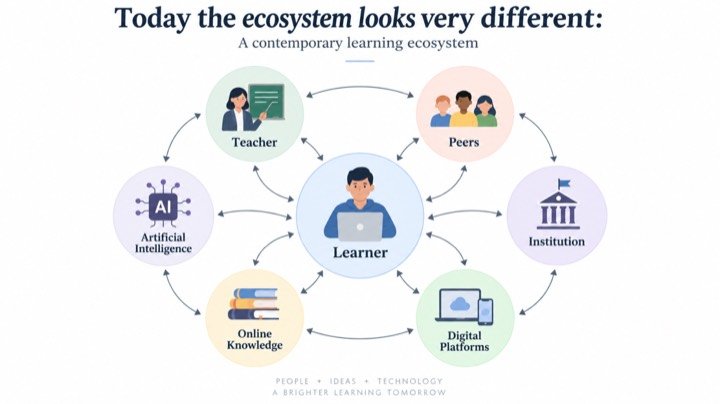
This demands a change in what we reward. A polished assignment should not count for more than a student’s ability to explain it. An AI-assisted answer should include opportunities to question its assumptions. A classroom should preserve independent drafting, oral defence, retrieval, practical engagement and collaborative debate. Learning continuity depends on connecting exposure with effort, retention, application and reflection; an impressive submission is only one visible moment in that longer process.
A Small Discipline of Preservation
What might cognitive self-preservation look like in everyday life? Read a few pages without interruption. Try answering the question before opening a chatbot. Recall an important idea without searching. Write a first paragraph in your own words. Discuss a disagreement with a person rather than only with a screen. Make something with your hands. Check the source of an impressive claim. And sometimes choose the slower route—not because difficulty is virtuous in itself, but because some abilities grow only when we exercise them.
None of this requires hostility to innovation. We do not strengthen the mind by denying it tools, just as we do not strengthen the body by refusing all machines. We strengthen human capability by using assistance deliberately while preserving opportunities for independent action. Excessive cognitive effort can overwhelm; thoughtful support can liberate. The task is to discern the difference.
The bigger risk of the AI age may not be that machines learn to think, but that people gradually lose the habit of doing so when a machine is always willing to start for them. We should welcome systems that help us reason more clearly, create more boldly and participate more fully in society. But the measure of progress cannot be the brilliance of their answers alone. It must also be the independence, empathy, practical skill and intellectual courage that remain ours.
The future will ask us to work with artificial intelligence. It should not ask us to surrender the responsibility of being intelligent.
References and further reading
Carr, N. (2008, July/August). Is Google making us stupid? The Atlantic. https://www.theatlantic.com/magazine/archive/2008/07/is-google-making-us-stupid/306868/
Harari, Y. N. (2018). 21 lessons for the 21st century. Spiegel & Grau.
Li, F.-F. (2023). The worlds I see: Curiosity, exploration, and discovery at the dawn of AI. Flatiron Books.
Lee, H.-P., Sarkar, A., Tankelevitch, L., Drosos, I., Rintel, S., Banks, R., & Wilson, N. (2025). The impact of generative AI on critical thinking: Self-reported reductions in cognitive effort and confidence effects from a survey of knowledge workers. Proceedings of the 2025 CHI Conference on Human Factors in Computing Systems. https://doi.org/10.1145/3706598.3713778
Risko, E. F., & Gilbert, S. J. (2016). Cognitive offloading. Trends in Cognitive Sciences, 20(9), 676–688. https://doi.org/10.1016/j.tics.2016.07.002
Roediger, H. L., III, & Karpicke, J. D. (2006). Test-enhanced learning: Taking memory tests improves long-term retention. Psychological Science, 17(3), 249–255. https://doi.org/10.1111/j.1467-9280.2006.01693.x
Sparrow, B., Liu, J., & Wegner, D. M. (2011). Google effects on memory: Cognitive consequences of having information at our fingertips. Science, 333(6043), 776–778. https://doi.org/10.1126/science.1207745
Sweller, J. (1988). Cognitive load during problem solving: Effects on learning. Cognitive Science, 12(2), 257–285. https://doi.org/10.1207/s15516709cog1202_4
Toffler, A. (1970). Future shock. Random House.
Turkle, S. (2015). Reclaiming conversation: The power of talk in a digital age. Penguin Press.
Wolf, M. (2018). Reader, come home: The reading brain in a digital world. Harper.