


When AI Learns to Rock
An AI assistant that remembers an earlier conversation can feel different from one that starts afresh each time. It may respond with greater relevance, recognise an ongoing project, or connect a new question to something discussed earlier. It is tempting to imagine the assistant has been thinking in the background, quietly learning while we were asleep.
Sometimes there really is a background process. Often, the explanation is more mundane: the system has stored information and supplied it to the model again. The difference is easy to miss, but it leads to one of the most interesting questions in contemporary AI. How much of an intelligent response comes from the model, and how much from the information environment built around it?
That is where context engineering frames in. My humble and central argument is that this emerging practice deserves attention well beyond software development. As AI systems become participants in our work and decision-making, organising their context also entails making choices about knowledge, judgement and responsibility.
The Context of Context Engineering
At AI Native DevCon 2026 in London, a presentation by Lamis from Anthropic’s Applied AI team raised an intriguing possibility: could AI become more useful by revisiting its past work? The talk connected context engineering—the careful management of information available to AI—with memory and a process described as “dreaming”. In this context, dreaming meant reviewing earlier interactions, identifying recurring patterns, and proposing improvements to stored memories. That idea feels familiar. We struggle with a problem, set it aside, and sometimes return with a clearer understanding. The comparison has limits: reviewing stored conversations is not evidence that a machine dreams. Yet it raises a fascinating question. Could tomorrow’s AI become more capable, in part, because of what it revisits between tasks?
And if machines increasingly organise their own memories, a second question follows: who decides what they should remember, revise or forget?
What Changes When an AI Appears to Learn
The word learning covers several different processes in everyday conversation. In machine learning, it commonly refers to changes in a model’s internal parameters during training. These changes can alter how the model behaves on future tasks. Training can run overnight, but it runs because a computational process has been scheduled or started, not because the user has gone to sleep.
A model can also adapt its answer to information included in the current conversation. This is contextual adaptation. The answer changes because the available input changes; the underlying model does not necessarily change. A third possibility is external memory: software stores selected facts or interaction records and retrieves them later. That creates continuity at the system level even when the model’s parameters remain fixed.
These distinctions explain why “the assistant remembered” and “the model learned” are not interchangeable. They also prompt a useful question whenever an AI product appears to improve over time: what exactly changed? Was the model retrained? Was a memory record updated? Was a better source retrieved? Or did the system simply receive a clearer instruction?
The answer matters in practice. Each mechanism requires a different kind of evaluation. A remembered fact can be outdated. A retrieved passage can be irrelevant. A training update can improve one capability while weakening another. Calling every change “learning” hides the engineering decisions that need scrutiny.
What Researchers Mean by Machine Dreaming
You spend an evening learning something new. By morning, some of it seems to have settled into place. Your brain has been busy while you slept, helping new memories settle alongside what you already know.
Could a machine benefit from something similar?
Researchers have been exploring this question for years. One influential idea, developed by McClelland and his colleagues, is that picking up new information quickly and gradually fitting it into existing knowledge requires different kinds of learning.
For AI, this creates a practical challenge. Training a system on something new can make it worse at something it previously did well. Imagine learning a new route to work and then struggling to remember the old one. Researchers call this catastrophic forgetting.
To tackle it, Tadros and colleagues investigated whether a sleep-like period of replay could help artificial networks preserve earlier learning. Deperrois and colleagues explored whether altered or deliberately challenging “dream” experiences could help networks learn useful patterns.
The word dreaming makes this research easy to picture. But we need to be careful about what it suggests. These systems revisit information or generate material for further learning. That does not show that they experience dreams—or feel anything at all.
There is another important distinction. Ask an AI to imagine a strange world, and it may produce a wonderful story. But creating that story does not, by itself, mean the machine has learned from it. For the experience to make a lasting difference, something must carry forward: a change in how the system works, or a memory it can use later.
The serious promise of machine dreaming lies here: can revisiting and reworking information help AI learn new things without losing what it already knows?
The Question Shifts from Memory to Context
Once we distinguish these processes, the connection to context engineering becomes clearer. Offline learning concerns how knowledge is retained or transformed. Context engineering concerns what information becomes available when the system must respond or act.
A modern AI application may draw on instructions, a conversation history, retrieved documents, stored preferences and information returned by tools. Those sources can disagree. Some may be stale. Some may be authoritative for one task but irrelevant to another. The system needs a way to select and organise them within a limited working context.
Prompt writing remains part of this process, but it is only part. A carefully worded request cannot repair every failure in the surrounding information supply. If a relevant document is never retrieved, the model cannot use it. If an old policy is presented without its date, the model may treat it as current. If a summary removes a qualification, a later answer may be more confident than the original evidence allows.
Context engineering therefore involves choices before, during and after the visible prompt. Which information should enter? In what order? With which dates and source labels? What should be retained for the next interaction? What should be corrected or forgotten? Who is authorised to make those changes?
These questions are technical, but their consequences are also intellectual and organisational.
Why a Larger Context Window is Not Enough
Imagine asking someone to find an important detail in a thick folder. The answer may be there, but buried among hundreds of pages. Handing them more paperwork does not necessarily help them find it.
AI faces a similar problem. Liu and colleagues’ Lost in the Middle study found that language models could use information more effectively when it appeared near the beginning or end of a long input, rather than when it was tucked in the middle. Simply giving a machine the right information does not guarantee that it will use it well.
Another test, called LongMemEval, evaluates how effectively AI assistants use information from earlier conversations. Its five assessment areas make the idea of “AI memory” easier to understand (Table 1):
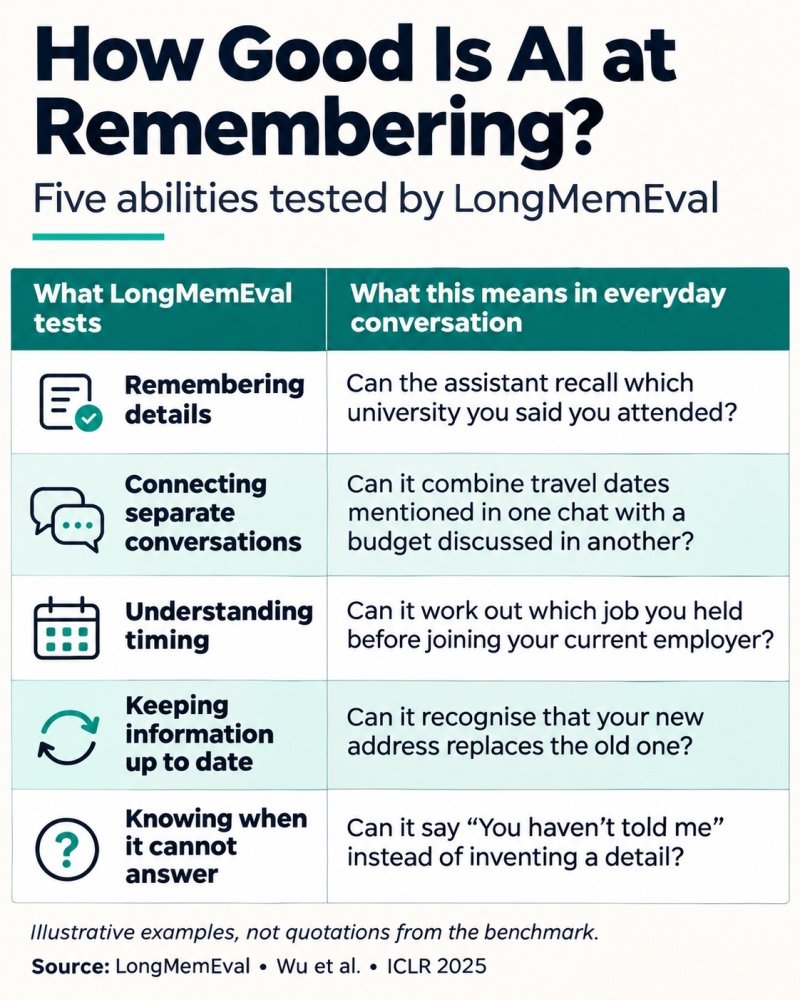
The results reveal why the way information reaches AI matters. Researchers compared performance when the relevant evidence was supplied directly with that when the system had to work through a longer conversation history (Table 2).
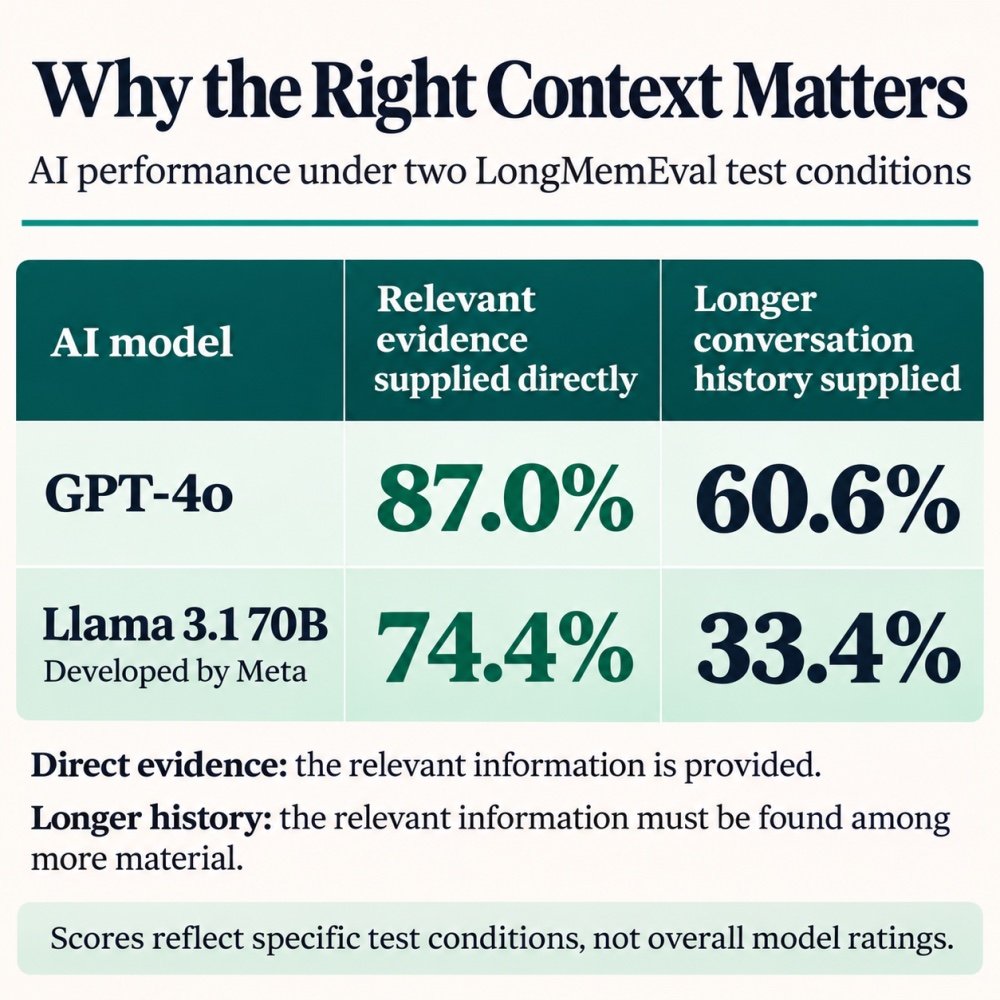
Think of the first condition as being handed the pages containing the answer. Researchers call this an oracle context. The second is closer to being given the whole folder and having to locate the useful material within it. The task becomes harder, even though the underlying model remains the same.
The gaps do not promise that better context engineering will improve every system by a fixed amount. They show that identifying the right evidence and making it usable are substantial parts of the challenge.
Research in engineering offers another example. Ghosh and Mittal compared two approaches to sourcing and supplying material to AI. The approach that added context to the retrieved material achieved a median correctness score of 0.83, compared with 0.62 for the traditional approach. Their statistical analysis supported the difference observed in that evaluation, although the findings do not establish that the approach prevents all invented answers or works equally well in other fields.
For anyone using AI, the practical lesson is clear: pay attention to what information the system receives, how it finds that information and how it is organised. Choosing a capable model matters. Providing it with the evidence it needs is part of making that capability useful.
Context is also a question of authority
Selecting information is never entirely neutral. A retrieval system determines which sources become visible. A summarisation process decides which details survive. A memory system determines which version of an event is carried into future interactions.
That means the person or organisation controlling the context influences the evidence on which the AI bases its recommendations. A source may be accurate yet incomplete. A highly ranked document may be convenient rather than authoritative. A record that was once useful may later become misleading. These are problems of knowledge management as much as of computation.
The implications become sharper when an AI system can use tools or take action. Material retrieved from the world should not automatically carry the authority of a user instruction. Likewise, remembering information does not, by itself, justify retaining it indefinitely. Decisions about access, correction and deletion should be part of the system’s design.
This is why I describe the broader responsibility as cognitive stewardship. The aim is to preserve people’s ability to question, verify and evaluate information while delegating some cognitive work to AI. The issue is not whether delegation is inherently good or bad. Rather, the issue is whether the arrangement leaves the human able to understand and challenge what is happening.
Three dimensions of a More Useful Framework
The Contextual Intelligence and Cognitive Stewardship framework, or CICS, brings together three dimensions of this problem. It is a proposed framework for research, not an empirically validated model.
The technological dimension asks whether the system receives relevant, reliable and appropriately organised information. Retrieval quality, source provenance, memory updates and context length all matter here. Its immediate concerns include accuracy and whether an answer is grounded in evidence.
The cognitive dimension asks what the arrangement does for the person using it. Does the system make supporting evidence visible? Can the user distinguish a source claim from a model inference? Does the interaction leave room for independent judgement? A correct answer can be useful without necessarily producing understanding, so those outcomes need to be assessed separately.
The governance dimension asks who controls memory, access and responsibility. Who can correct a persistent record? Which source takes precedence when documents conflict? Who remains accountable when an automated recommendation is acted upon? A technically effective system does not answer these institutional questions by itself.
The value of putting the three dimensions together is that it makes success harder to define too narrowly. Fast answers and high benchmark scores matter. They are not the only outcomes that matter when an AI system becomes part of an organisation’s knowledge practices.
What It Means to Learn Context Engineering
For a practitioner, learning context engineering includes understanding retrieval, memory, evaluation and the constraints of the model. For a researcher, it also includes deciding what counts as evidence and how to separate an established result from an attractive hypothesis. For a manager or educator, it involves examining which responsibilities can be delegated and which capabilities should remain actively exercised by people.
A useful starting discipline is to inspect the evidence supplied to the system, rather than judging only the fluency of the final answer. Check whether sources are relevant, whether their dates are visible and whether qualifications survive summarisation. Examine whether the system can recognise an evidence gap instead of filling it with plausible language.
A second discipline is to evaluate context changes while keeping the model and task set stable. If several things change together, it becomes difficult to know what produced an improvement. Where possible, compare performance on the same questions and inspect individual errors, not just an average score. A retrieval change that helps many answers can still fail badly on a consequential subset.
A third discipline is to examine human outcomes separately. Faster task completion does not prove better learning. Agreement with an AI recommendation does not prove justified trust. If the objective includes stronger judgement or knowledge retention, those outcomes require direct measures, including opportunities for people to work without assistance.
These are proposed habits of responsible practice. They are also research questions. We still need studies that show when context engineering strengthens human capability and when it merely makes dependence more convenient.
The Deeper Question is How We Organise What We Know
“Does AI dream?” is a compelling question because it connects unfamiliar technology with an intimate human experience. It becomes more useful when we unpack the metaphor. Some systems replay or simulate experiences. Some update parameters. Others remember through external records. These processes should be understood on their own terms.
The broader shift is that intelligence is increasingly expressed through relationships among models, memory systems, information sources, and human judgement. What reaches the model at the point of decision can be as important to a particular answer as what it learned during training. This kind of process curation gives context engineering significance beyond better prompts. Prompt engineering is about how we ask AI to do something. Context engineering is about giving it the information it needs to do that task well. The two work together: a good prompt clarifies the task, and good context gives the AI a sound basis for tackling it. It is a way of shaping the conditions under which AI participates in our knowledge and decisions. The challenge is to design those conditions so that evidence remains inspectable, responsibilities remain clear, and people retain the capacity to question the systems they use.
Sources and Further reading
· McClelland, McNaughton and O’Reilly (1995), complementary learning systems: https://doi.org/10.1037/0033-295X.102.3.419
· Deperrois and colleagues (2022), perturbed and adversarial dreaming: https://doi.org/10.7554/eLife.76384
· Tadros and colleagues (2022), sleep-like replay and catastrophic forgetting: https://doi.org/10.1038/s41467-022-34938-7
· Liu and colleagues (2024), Lost in the Middle: https://doi.org/10.1162/tacl_a_00638
· Wu and colleagues (2025), LongMemEval conference results: https://iclr.cc/media/iclr-2025/Slides/28290_OvN8vCf.pdf
· Ghosh and Mittal (2025), contextual retrieval in engineering: https://doi.org/10.3389/frai.2025.1697169
· Risko and Gilbert (2016), cognitive offloading: https://doi.org/10.1016/j.tics.2016.07.002
· Anthropic (2025), effective context engineering for AI agents: https://www.anthropic.com/research/effective-context-engineering-for-ai-agents
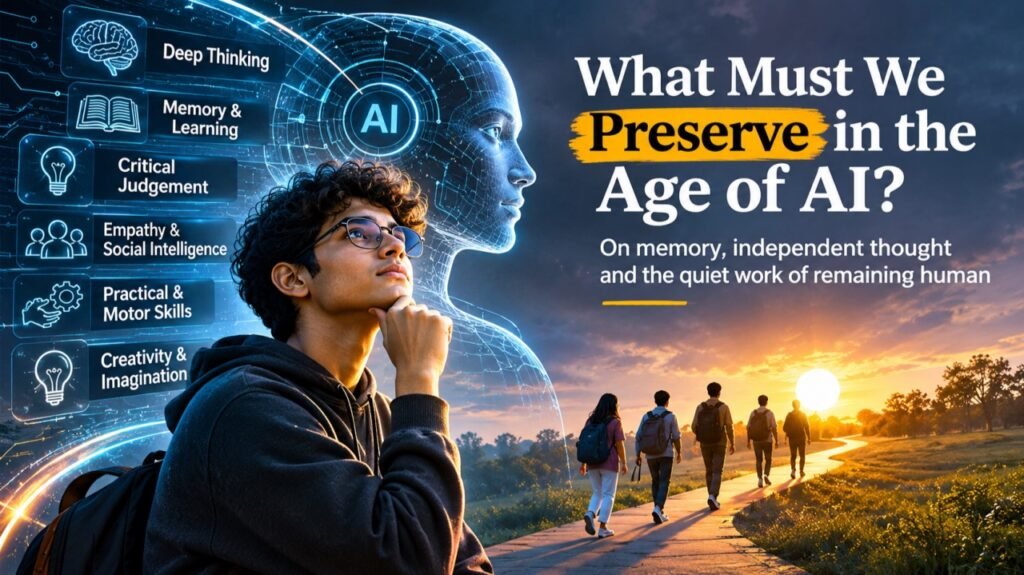
Continue the series. Part two: What Must We Preserve in the Age of AI? Memory, Independent Thought and the Quiet Work of Remaining Human.