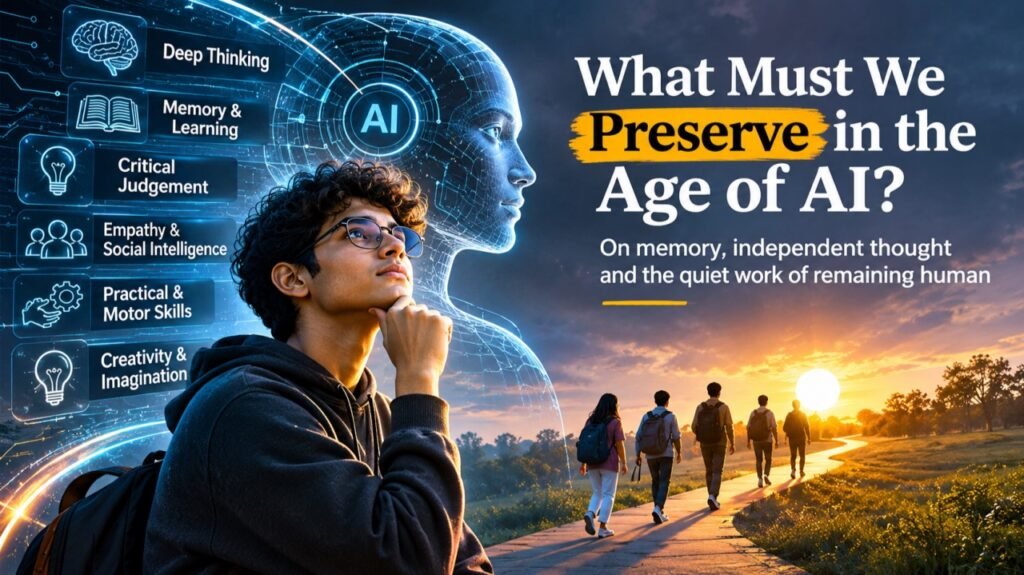


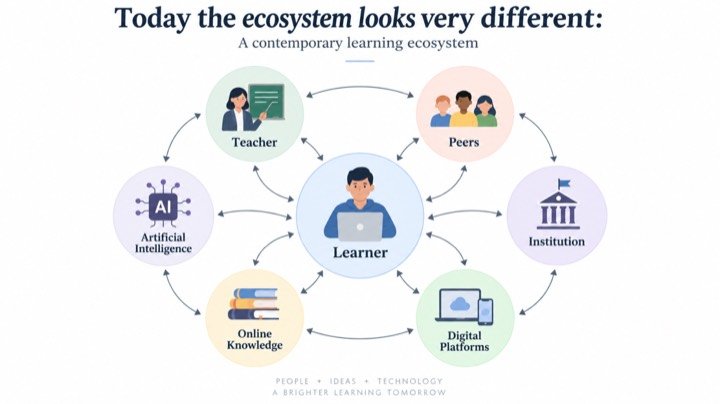

In the past, people often struggled with communication, making mistakes and hesitating before answering tough questions. Today, artificial intelligence can quickly generate persuasive arguments, professional presentations, and thoughtful responses. While these results are impressive, they raise an uncomfortable question: are we truly becoming better human beings, or just better at presenting ourselves? The debate about AI often focuses on employment and efficiency, but it also shapes how we view ourselves and our limitations. Ultimately, the real concern may not be machines resembling humans, but whether we feel increasingly uncomfortable being human in their presence.
Are We Becoming Too Perfect?
There was a time when people struggled to find the right words, made mistakes in their writing, hesitated before answering difficult questions, and occasionally failed to communicate what they truly felt. These were ordinary expressions of being human. Today, artificial intelligence can write a persuasive argument, prepare a professional presentation, compose an apology, improve a photograph, or generate an apparently thoughtful response within seconds. What once required reflection, practice, or considerable effort can now be accomplished with a few instructions to a machine. The results are often impressive. But beneath this technological achievement lies an uncomfortable question: are we becoming better human beings, or merely better at presenting ourselves as better human beings?
Much of the contemporary debate surrounding artificial intelligence concerns the future of employment, the displacement of workers and the efficiency of machines. These are legitimate concerns, particularly as AI becomes increasingly capable of performing tasks once associated with human intelligence. Yet the debate often overlooks something closer to our everyday lives. AI is not only changing how we work; it is beginning to influence how we see ourselves, what we expect from others and how willing we are to accept our own limitations. Perhaps the deeper issue is not whether machines will eventually resemble human beings, but whether human beings will increasingly feel uncomfortable being human in the presence of machines.
We Have Been Here Before, but This Time It Is Different
The world witnessed a comparable technological transition during the COVID-19 pandemic. As educational institutions closed their physical classrooms, online learning became a necessity. Classes continued, assignments were submitted, and examinations were conducted through digital platforms. Technology unquestionably helped maintain educational activity during an extraordinary crisis. However, an important question remained insufficiently addressed: did the continuation of teaching necessarily mean that learning had continued with equal effectiveness?
There was a difference between attending an online class and understanding its content, and between submitting an assignment and developing the knowledge required to prepare it. The technology enabled participation, but participation was not always synonymous with learning. This was not a failure of online education itself. It was a reminder that the presence of a technological solution does not automatically guarantee the achievement of its intended human purpose.
Artificial intelligence brings the same problem into sharper focus. A student may submit an excellent assignment without understanding its arguments. A professional may produce an impressive report without the analytical ability reflected in its contents. A person may send an emotionally moving message without having spent much time considering the feelings expressed. These possibilities do not establish that everyone using AI is dishonest or intellectually passive. Many people use such tools responsibly and gain genuine benefits. Nevertheless, they make it increasingly difficult to distinguish between what individuals have accomplished and what technology has accomplished on their behalf.
And this time, the consequences extend beyond education. They penetrate deep inside our workplaces, relationships, social identities and understanding of personal worth.
The Growing Pressure to Appear Perfect
We’ve always craved appreciation. We seek recognition for our achievements, reassurance about our abilities, and acceptance within our social circles. And I don’t think there is anything unnatural about these desires. The problem arises when the pursuit of recognition gradually becomes an obligation to hide anything that might reveal our limitations.
Social media had already encouraged this tendency long before generative AI became widely accessible. Carefully selected photographs, idealised personal experiences and public declarations of achievement created a world in which ordinary lives could appear remarkably successful. We began comparing our everyday struggles with other people’s most favourable moments. AI now makes this process considerably easier. A photograph can be enhanced beyond natural appearance, an ordinary statement can become intellectually sophisticated, and a modest accomplishment can be presented in unusually impressive language.
The difficulty is not that these representations are necessarily false. A refined photograph may remain recognisably authentic, while an AI-assisted message may genuinely communicate the sender’s intentions. The difficulty arises when constant refinement changes the standards against which everyone is judged. If every photograph looks flawless, natural appearances begin to seem inadequate. If every professional communication appears exceptionally articulate, ordinary expression may seem incompetent. If every public achievement is presented as extraordinary, normal progress may begin to look like failure.
We may gradually create a society in which perfection is no longer admired as an exceptional achievement but expected as a minimum condition of acceptance.
There is an irony here. Technology was expected to reduce human effort and make life easier. Yet when everyone gains access to tools capable of producing exceptionally polished results, expectations may rise accordingly. What initially offers a competitive advantage eventually becomes something people feel compelled to use simply to avoid falling behind.
The pressure to appear perfect then survives, even as the technology intended to simplify our lives becomes more sophisticated.
Are We Escaping Our Imperfections or Ourselves?
Imperfection is often discussed as though it represents something undesirable that should eventually be eliminated. But not all imperfections are deficiencies. A hesitation before answering a difficult question may reflect careful thought. An unsuccessful attempt may reveal where further learning is needed. An awkward expression of affection may communicate something more personal than a perfectly composed message.
Human development is rarely a smooth progression from ignorance to understanding or from weakness to strength. It involves uncertainty, frustration, revision and the gradual discovery of one’s abilities. A person learning to write must first produce imperfect sentences. A student learning mathematics must encounter problems they cannot immediately solve. An individual developing emotional maturity must sometimes misunderstand others and learn from the experience.
If technology removes the visible evidence of these processes, it may make us appear more capable without necessarily making us more capable.
This raises an important distinction between correcting a limitation and concealing it. Someone who uses AI to understand a difficult concept may become genuinely more knowledgeable. Someone who uses AI to produce an answer without attempting to understand it may successfully conceal the absence of knowledge. Both individuals can produce an excellent result, but the consequences for personal development differ fundamentally.
The same distinction applies to professional communication and interpersonal relationships. Assistance that allows people to express their genuine thoughts more clearly may strengthen their confidence. Assistance used primarily to maintain an identity that feels impossible to sustain independently may create a different kind of dependence.
The danger is not the use of AI itself. It is the gradual belief that our unassisted selves are no longer good enough to be seen.
The Workplace: Better Outputs, Uncertain Abilities
Consider the modern workplace. Organisations are understandably interested in technologies that improve productivity, reduce costs and enable employees to accomplish more within limited time. AI can support these objectives and, when properly employed, can make work more interesting by reducing repetitive tasks.
But the relationship between productivity and competence requires careful consideration.
An employee may prepare a sophisticated business proposal with AI assistance and receive appreciation for its clarity and presentation. That appreciation may be entirely justified if the employee understands the proposal, contributes substantive ideas, and can take responsibility for its recommendations. However, if the employee cannot explain the assumptions behind the proposal, the organisation may be rewarding the appearance of expertise rather than expertise itself.
The problem becomes more serious when organisations begin treating AI-enhanced outputs as the normal standard of employee performance. Workers may feel compelled to produce increasingly polished documents, faster responses and continuously refined presentations, regardless of whether the underlying tasks require such sophistication. Those who work independently may appear slower or less capable, even where their understanding is stronger.
Instead of reducing workplace anxiety, technology may introduce a new fear: the fear of being evaluated without technological assistance.
A healthy organisation should therefore ask two questions whenever AI improves performance. What has the technology enabled the employee to accomplish? And what has the employee learned or retained through the process?
These questions are complementary. A productive workplace needs both effective technological systems and people capable of understanding what those systems produce.
Education: The Difference Between Knowing and Showing
The implications are even more consequential for children and young adults.
Education is not just about producing correct answers. It is also about developing curiosity, patience, reasoning, judgement and the capacity to recognise one’s own mistakes. These qualities emerge gradually, often through uncomfortable experiences.
A student who struggles with a complex problem may eventually discover an approach that changes their understanding. The struggle itself is not always desirable, and good teaching should reduce unnecessary frustration. Yet some forms of intellectual difficulty are valuable because they require learners to confront the limits of their present knowledge.
If AI supplies finished answers before students have engaged with the underlying questions, education risks becoming an exercise in producing acceptable submissions rather than acquiring durable capabilities.
This does not mean that AI should be excluded from classrooms. It can explain difficult concepts, provide additional practice, support students with disabilities and make learning resources available to those who previously lacked access. Indeed, refusing such possibilities would be difficult to justify.
The challenge is to design learning experiences in which students use AI to become more capable rather than to avoid discovering what they do not know.
Future generations should be proficient in using technology, but they should also develop confidence in their ability to question, interpret and disagree with it. The real educational achievement lies not in producing the most impressive answer, but in understanding why an answer deserves to be accepted.
When Artificial Perfection Becomes Social Reality
There is another dimension to this social problem that transcends productivity and learning. Human beings construct their understanding of normality, in part, by observing the behaviour and achievements of others.
When technologically enhanced representations become common, they can begin to shape what society considers ordinary. A carefully crafted image is no longer seen as an exception. An exceptionally polished statement becomes a routine expectation. A constantly responsive digital companion may influence how people perceive the comparatively imperfect communication of their friends or family members.
The distinction between representation and reality then becomes increasingly difficult to maintain, not necessarily because people cannot recognise AI, but because artificial standards begin to shape their expectations of real human behaviour.
This may have consequences for relationships.
Human interactions are rarely perfect. People misunderstand one another, occasionally fail to find the right words, and sometimes struggle to respond with the patience expected of them. These shortcomings can be frustrating, but relationships also develop as people learn to live with differences, negotiate disagreements, and acknowledge mistakes.
AI can offer helpful companionship and communication support, especially for people facing isolation or difficulty expressing themselves. Yet if individuals increasingly seek interactions that minimise discomfort, uncertainty and disagreement, they may become less willing to engage with the ordinary difficulties of reciprocal human relationships.
A society that becomes exceptionally skilled at producing the appearance of understanding may not necessarily become better at understanding one another.
The Hidden Cost of Constant Improvement
Human history repeatedly shows that the pursuit of excellence can yield extraordinary achievements. Scientific discovery, artistic creation and social progress would be difficult to imagine without individuals striving to improve existing conditions.
Yet improvement and perfection are different ideals.
Improvement acknowledges an existing condition and seeks to develop it. Perfectionism may treat the existing condition as unacceptable until it meets an imagined standard.
As that standard is continually raised through technological enhancement, people may find themselves pursuing a destination that remains permanently out of reach. Each improvement becomes the new expectation, and each achievement creates pressure for further refinement.
Consequently, there may be less satisfaction in accomplishment even as the quality of observable performance improves.
This is particularly troubling because some qualities that make human life meaningful cannot be enhanced merely by increasing efficiency. Empathy requires attention to another person’s experience. Moral judgement involves accepting responsibility for difficult choices. Creativity may arise from unconventional ideas that initially seem unrefined. Personal growth often demands confronting truths about ourselves that we would rather avoid.
Technology can assist these processes, but it cannot make the responsibility for living through them disappear.
We should therefore be cautious about defining progress solely by the elimination of human effort. Some effort is unnecessary and should be reduced. Other forms of effort contribute directly to the development of understanding, relationships and character.
A society that fails to distinguish between them may become highly efficient without becoming correspondingly wiser.
A Different Understanding of Human Progress
None of these concerns justifies rejecting AI. Such a response would overlook its enormous potential to support learning, accessibility, creativity, healthcare and economic opportunity. For someone struggling with language, AI may provide a means to communicate ideas that would otherwise go unheard. For a student with limited access to specialised teaching, it may offer valuable explanations. For a professional managing repetitive administrative work, it may free up time for substantive decisions.
These are meaningful improvements in human capability, not evidence of its erosion.
The challenge is to develop a social understanding of technology that does not equate assistance with weakness or polished output with personal superiority. We should recognise that using AI responsibly may itself reflect sound judgement, while also recognising that the ability to obtain a convincing answer is not equivalent to understanding it.
Educational institutions must preserve the distinction between completing a task and learning from it. Organisations must recognise independent judgement alongside productivity enabled by technology. Families and social environments should encourage young people to understand that their personal worth is not determined by how closely they resemble idealised representations.
Equally important is the willingness to accept that a human being does not become less worthy because of an imperfect sentence, an uncertain answer, an ordinary appearance, or an incomplete achievement.
Our society should leave room for people who are still learning, still making mistakes, and still discovering who they are.
The Question We Must Ask
The future of artificial intelligence is often discussed in terms of what machines will be able to accomplish. Perhaps we should devote equal attention to what human beings will continue to feel comfortable doing without them.
Will we still be willing to write something imperfectly, knowing that a machine could express it better? Will we allow children to make mistakes without immediately correcting every result? Will we value the hesitant yet sincere expression of emotion over a beautifully generated message? Will workplaces continue to recognise thoughtful judgement even when it arrives without an elaborate presentation?
These questions are not arguments against technological progress. They concern the kind of society we wish that progress to serve.
The real danger may not be that AI will become more intelligent than human beings. It may be that we begin measuring our humanity against the apparent perfection of what AI produces, gradually mistaking our natural limitations for unacceptable defects.
We may succeed in creating a world that looks increasingly intelligent, articulate, attractive and accomplished. But if maintaining that appearance requires individuals to become uncomfortable with their genuine selves, the achievement will remain incomplete. Perhaps the most important freedom in an AI-driven world will be the freedom to remain imperfect without feeling inadequate. After all, being human was never meant to be a demonstration of perfection. It is an unfinished process of becoming.