


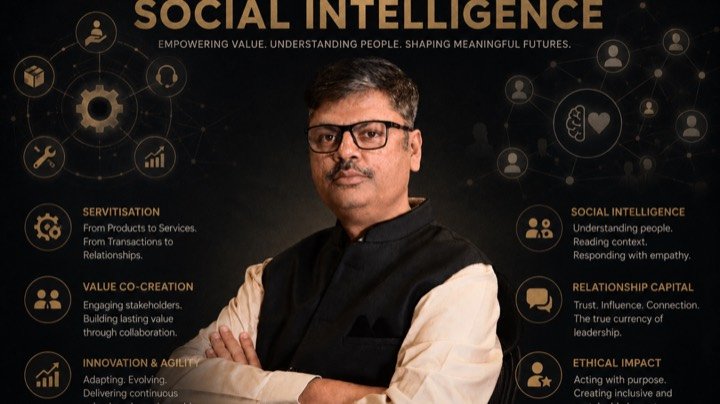
The world we live in is governed by rapid technological advancements and ever-changing circular economic circumstances. The idea of servitization has evolved into an innovative approach that is revolutionising how businesses deliver value to their clients. This trend has far-reaching ramifications for society, transcending traditional business models. As goods and services become increasingly intertwined, even domains such as social intelligence – the capacity to navigate complex human interactions within a given society – take a hit.
When was the last time we heard of corporations hiring lighting solutions as a service to brighten their office spaces? If your answer is positive, then welcome to the world of next-gen value-creation models that augment service variability, i.e., servitization. The lighting giant Philips, known as a market leader in high-end LED lamps, provides the lighting solution for Amsterdam-Schiphol Airport as a service. It is a win-win solution for both: the airport authority does not need to buy expensive lights, and Philips owns all the lamps and other equipment, which it uses for periodic replacement of damaged lamps and for reusing/refurbishing the usable parts by harvesting them from the old ones. This arrangement of circular lighting not only increased the efficiency of both but also allowed the airport authority to save a significant amount.
The world we live in is governed by rapid technological advancements and ever-changing circular economic dynamics. Therefore, to tackle the uncertainties inherent in this dynamic environment, the idea of servitisation has emerged as an innovative approach that is revolutionising the way businesses deliver value to their clients. This trend has far-reaching ramifications for society, transcending traditional business models. As goods and services become increasingly intertwined, even domains such as social intelligence – the capacity to navigate complex human interactions within a given society – are taking a hit.
The idea first emerged in 1960 when Bristol Siddeley, a British aerospace engine manufacturer (now owned by Rolls Royce), offered to improve the efficiency of its Viper engines under the ‘power-by-the-hour’ plan, in which pilots were asked to focus on engine power as a service, thereby freeing them from the burden of capital expenditure on purchasing the engine and its parts. Later, Sandra Vandermerwe and Juan Rada (1988) popularised the idea by highlighting the need for manufacturers to look beyond manufacturing and to focus on enhancing efficiency by providing services that extend product usability for a sustainable future in this circular economy. It is a new approach, pervasive across industries, that focuses on providing solutions, experiences, and ongoing relationships, rather than just selling products. This shift is happening across industries, including manufacturing, technology, healthcare, and beyond. As more companies embrace service-oriented models, society’s interactions are becoming more interconnected. Traditional models of social interaction are being challenged as individuals, organisations, and communities engage in ever-more intricate and nuanced relationships, especially among the digital natives of Society 5.0. As products and services merge into seamless experiences, the boundaries between consumers and producers are blurring. To successfully navigate this interconnected landscape, heightened social intelligence is essential for understanding the complexities of these evolving relationships. There is an increased focus on services that prioritise the human element. To maintain a fruitful business partnership, it is crucial to understand the social dynamics at play and respond to unexpressed requirements in both B2B and B2C scenarios.
The emergence of servitization has placed data at the heart of the modern socio-circular economy. By gathering data, businesses can tailor their services and offerings to individual preferences. Nevertheless, this data-oriented strategy has raised ethical issues regarding privacy, consent, and the appropriate handling of information. To possess true social intelligence, it is necessary to understand how data-driven choices affect both individuals and society at large. The strategic intent of servitization fosters the creation of collaborative networks between businesses and customers, with interconnected services and products forming the basis of these networks. As social intelligence becomes increasingly vital in this landscape, it requires a thorough understanding of these networks, the ability to navigate collaborative environments, and the capacity to build meaningful connections in a rapidly evolving economic environment.
Although servitization can have positive effects on social intelligence, several obstacles remain. Job loss, unequal distribution of wealth, and ethical use of data are among the critical issues that require thoughtful attention. Nevertheless, it has the potential to foster enhanced social collaboration, inventive solutions to complex problems, and the establishment of more comprehensive and sustainable societies.
As businesses continue to embrace service-oriented approaches, it’s crucial to weigh the effects on workplace equity. This transformation presents fresh prospects and obstacles that require proactive attention to preserve impartiality, diversity, and inclusiveness within companies. The servitization wave is altering the corporate terrain beyond mere commercial frameworks and income streams. Servitisation is a powerful transformation that goes beyond altering a company’s products and services. It also has a profound impact on its overall corporate culture. As organisations pivot towards offering comprehensive solutions and exceptional experiences, they must also adjust their internal frameworks to facilitate these shifts. This entails rethinking hierarchical structures and cultivating a workplace culture that encourages teamwork, creativity, and flexibility. When organisations transition towards servitisation, one of their primary obstacles is to guarantee that all of their personnel have access to the necessary training and skill development programmes. As organisations move away from traditional manufacturing functions to service-oriented roles, their staff needs to possess the essential skill sets. To ensure fairness and parity, organisations employ inclusive training programmes that concentrate on upskilling and reskilling workers at every level of the company.
The implementation of servitization principles provides corporations with an opportunity to scrutinise and address gender and diversity imbalances in their workforce. By promoting inclusivity and diversity, businesses can tap into a broader pool of viewpoints and abilities, fostering creativity and innovation. Essential to building a fair workplace are initiatives such as mentorship programs, diversity-focused hiring strategies, and inclusivity training. In today’s context, the service-oriented model emphasises collaboration and teamwork to overcome challenges. Increasingly, companies recognise the value of incorporating a variety of perspectives in decision-making processes. This approach not only yields better outcomes but also strengthens a sense of unity among staff. To achieve this, organisations cultivate an environment of open and honest communication, inviting input and feedback from employees at every level. The ultimate objective is to cultivate a culture of inclusivity, where every staff member feels respected and appreciated. The use of digital technologies and greater connectivity often accompanies servitisation. Companies are recognising the evolving nature of work and adopting flexible work arrangements that cater to diverse lifestyles and requirements. These inclusive policies include remote work options, adjustable work hours, and family-friendly policies, promoting fairness and a healthy work-life balance.
Servitization compels companies to look beyond economic impact and consider their social and environmental responsibilities. To uphold the values of equality and sustainability, many businesses are embracing Corporate Social Responsibility (CSR) initiatives. This entails backing community programmes, advocating for environmental causes, and investing in the overall welfare of society. While servitization has had a beneficial impact on corporate equality, there are still challenges that must be addressed. Companies are proactively addressing issues such as unconscious bias, inequitable access to opportunities, and the need for ongoing education and awareness. By embracing these challenges as opportunities for development and progress, businesses can uphold their commitment to equality amidst a constantly evolving business landscape. Servitization is a profound societal shift that extends beyond a mere business approach. It influences how people interact with each other as goods and services become increasingly interrelated. As a result, individuals and communities must adjust to this evolving landscape. The task at hand is not only to grasp the concept of servitization but also to harness it for the betterment of society. This will pave the way for a new era of social intelligence marked by collaboration, flexibility, and ethics.
The effects of servitization on corporate equality are both significant and complex. To ensure that the benefits of this transformation are distributed equitably among all employees, corporations must adopt a comprehensive and forward-thinking approach. By fostering inclusivity, promoting diversity, and embracing responsible business practices, companies can not only adapt to the demands of servitization but also contribute to a more just and equal society. The pursuit of equality becomes an integral part of the broader narrative of corporate growth in the age of servitization.