


AI applications are no longer just another set of technological tools; they are reshaping us, i.e., work, education, cognition, and even the very meaning of human relevance. As organisations worldwide automate tasks and redesign labour structures, young people increasingly face uncertainty about their survival in an AI-driven economy. Now the big question before us is whether AI is truly neutral. The article explores competing theoretical perspectives on technology and society, and argues that the future belongs not to those who merely use AI, but to those who retain the capacity for independent thought, ethical judgment, adaptability, and deeply human intelligence.
The world today is entering a phase where the deepest anxiety among young people is no longer academic competition alone, but existential uncertainty. Students across universities increasingly ask uncomfortable questions: Will AI eliminate my profession? Are human beings becoming cognitively dependent on machines? Will countries without technological capability become irrelevant in the coming decades? And perhaps most disturbingly, are we slowly engineering the conditions for our own obsolescence?
These fears are not irrational. They stem from observable realities unfolding across the global economy. Companies such as Meta, Microsoft, Oracle, IBM, Amazon, Google, Cloudflare, Duolingo, Klarna, Chegg, and Tata Consultancy Services are restructuring operations amid unprecedented investments in artificial intelligence and automation. Reports from 2025 and 2026 indicate that tens of thousands of workers across technology, consulting, customer support, programming, HR, media, and analytics have either lost their roles or seen their work fundamentally altered due to AI-driven operational restructuring.
Meta alone reportedly initiated plans affecting nearly 8,000 employees, reallocating resources aggressively towards AI infrastructure and “superintelligence” initiatives. Microsoft simultaneously expanded AI investments while reducing parts of its workforce. IBM openly acknowledged using AI to automate parts of HR processes. Klarna experimented heavily with AI-driven customer service replacement before partially reassessing the human consequences of excessive automation. Duolingo reduced its dependence on contractors through AI-assisted translation systems.
Yet despite these developments, the question “Is AI neutral?” remains deeply misunderstood.
The simplistic answer is ‘No’. Artificial Intelligence is not neutral because no technology emerges in a social vacuum. AI systems inherit the assumptions, priorities, biases, exclusions, and economic motivations embedded in the datasets and institutions that create them. A facial-recognition system trained predominantly on Western datasets may fail to accurately identify darker skin tones. Recruitment algorithms trained on historical hiring patterns may unintentionally reproduce gender or racial discrimination. Recommendation systems designed to maximise engagement may privilege outrage, sensationalism, or ideological extremity, as emotional intensity sustains platform attention.
Eminent philosopher Langdon Winner famously argued that technologies possess political qualities. His argument remains profoundly relevant in the age of AI. Algorithms increasingly determine visibility, employability, credibility, policing patterns, access to insurance, and social legitimacy. AI, therefore, does not only process information; it shapes social reality itself.
However, another competing perspective deserves attention. Technological Determinism, associated with thinkers like Marshall McLuhan and Jacques Ellul, holds that technologies gradually restructure societies independent of individual intentions. From this perspective, AI may not be “biased” in a moral sense but rather an inevitable extension of technological evolution that societies adapt to. In contrast, the Social Construction of Technology theory, developed in the 1980s by Trevor Pinch and Wiebe Bijker, argues that societies shape technologies through political choices, cultural negotiations, and institutional power structures. The tension between these theories is paramount to understanding modern AI governance. Is AI controlling humanity, or is humanity unconsciously redesigning itself around AI systems?
The answer is likely both.
Another influential framework relevant here is Joseph Schumpeter’s theory of Creative Destruction (1942). Every major technological revolution destroys existing economic structures while simultaneously generating new industries. The Industrial Revolution eliminated many forms of agricultural labour but created manufacturing economies. Computers automated clerical work while creating the software industry. AI appears poised to repeat this pattern, though at a much faster and cognitively disruptive scale.
The difference today is that AI is no longer limited to replacing physical labour or repetitive tasks. Generative AI increasingly operates in domains once considered uniquely human — writing, coding, designing, analysing, composing, teaching, and even simulating emotional interaction. This is why the current technological transition feels psychologically distinct from earlier industrial shifts. Human beings are witnessing machines enter symbolic and creative territories once associated with human identity. Thus, the situated conditions prevailing have produced what may be called a crisis of cognitive relevance.
For centuries, education systems rewarded memorisation, procedural correctness, repetition, and standardised conformity. Yet generative AI can now summarise books, draft legal documents, generate academic essays, write software code, analyse financial data, compose music, and produce hyper-realistic media in seconds. Consequently, the educational foundations of the twentieth century are increasingly becoming insufficient for the twenty-first.
However, emerging conditions do not necessarily mean humanity is approaching an immediate apocalypse. Popular imagination often visualises an AI catastrophe through cinematic narratives of robot uprisings or machine domination. Yet contemporary risks are subtler and perhaps more dangerous precisely because they appear gradual and normalised.
The real danger may not be physical extermination but intellectual dependency.
Psychologists describe a phenomenon known as cognitive offloading, where individuals externalise mental effort to technological systems. GPS weakened geographical memory. Smartphones reduced memorisation of phone numbers. Search engines altered information retrieval habits. Generative AI may now weaken deep reasoning itself if individuals continuously outsource interpretation, synthesis, and critical reflection to machines.
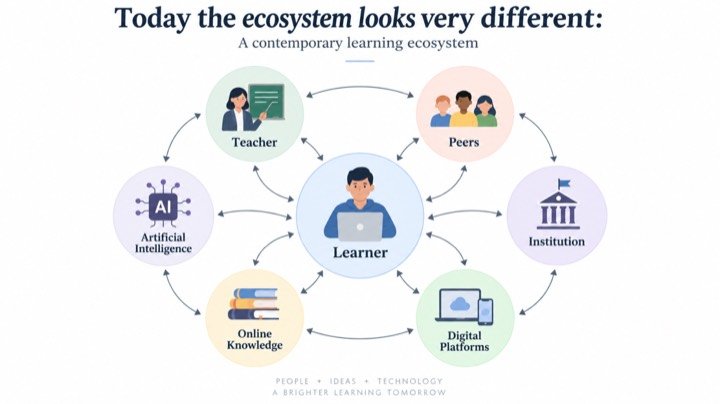
This is where competing educational philosophies become critically important. Behaviourism, which emphasised repetition and conditioned learning, becomes increasingly inadequate in AI-mediated societies where information retrieval is instant. Constructivism, advocated by Jean Piaget and Lev Vygotsky, becomes more relevant because it emphasises meaning-making, contextual understanding, and cognitive development through active engagement. Connectivism, proposed by George Siemens and Stephen Downes, becomes equally important because knowledge today exists across distributed digital networks rather than within isolated individuals.
Similarly, Howard Gardner’s Theory of Multiple Intelligences gains renewed significance because future economies will increasingly reward multidimensional capacities rather than narrow academic standardisation. Emotional intelligence, interpersonal intelligence, ethical reasoning, systems thinking, narrative ability, and adaptive creativity may become more economically valuable precisely because machines struggle to authentically embody them.
At the same time, Complexity Theory reminds us that modern societies are interconnected, adaptive systems where small technological shifts can produce disproportionate social consequences. AI-generated misinformation, algorithmic political manipulation, deepfakes, automated propaganda, and synthetic emotional influence could destabilise democratic trust itself. In such environments, truth becomes increasingly difficult to distinguish from simulation.
This is why educational institutions must radically rethink their purpose.
The universities of the future cannot simply function as certification factories. They must become environments that cultivate adaptive intelligence. Students must learn not only how to use AI tools but also how to question, audit, interpret, and ethically coexist with them. Future-ready education, therefore, requires interdisciplinary synthesis. Philosophy must coexist with programming. Psychology must intersect with data science. Ethics must accompany engineering. Sociology must engage with algorithmic governance. Students should understand not only technological systems but also the human consequences those systems produce.
Equally important are meta-skills — the higher-order capacities that enable survival amid uncertainty. The future belongs increasingly to individuals capable of learning continuously, adapting rapidly, communicating persuasively, collaborating across disciplines, and exercising ethical judgment in ambiguous situations.
Ironically, the rise of intelligent machines may increase the value of deeply human qualities. Empathy, trust-building, leadership, moral reasoning, negotiation, cultural interpretation, and emotional resilience may become strategic advantages rather than just “soft skills.” The future economy may reward those who can integrate machine intelligence with human depth. This also raises a geopolitical concern. Nations with weak technological ecosystems may not disappear physically, but they risk becoming digitally dependent colonies of stronger technological powers. In earlier centuries, imperial power emerged through military control and industrial infrastructure. In the AI era, power increasingly rests on data ownership, semiconductor production, cloud infrastructure, algorithmic dominance, and computational sovereignty.
Countries unable to participate meaningfully in AI development may become passive consumers of foreign technological systems, with limited control over digital governance, labour markets, educational ecosystems, or informational autonomy. Yet despite these transformations, one fundamental distinction between human beings and machines remains.
AI can generate probability. Humans generate meaning. AI can imitate emotion. Humans experience suffering, morality, beauty, love, guilt, purpose, and transcendence. The greatest challenge of the AI era is therefore not preventing machines from becoming human. It is preventing humans from surrendering the very qualities that make them human. The future will not belong exclusively to technologists, nor exclusively to philosophers. It will belong to those capable of integrating intelligence with wisdom, efficiency with ethics, and innovation with humanity.
The students who thrive in the coming decades will not necessarily be those who memorise the most information. They will be those who remain intellectually flexible, emotionally resilient, technologically literate, ethically grounded, and profoundly human within increasingly automated societies. Because the most dangerous apocalypse may not arrive through machine rebellion. It may arrive quietly when human beings stop thinking deeply for themselves.
Let’s try and paint some pictures here of the future of humanity in the age of AI.
When calculators first entered classrooms, many feared students would stop learning mathematics. Years later, mathematics did not disappear — but mental arithmetic weakened, while higher-order analytical thinking grew in importance. Similarly, when GPS became common, people reached destinations faster, yet gradually lost the ability to navigate unfamiliar places independently. Convenience increased, but cognitive dependence quietly followed.
Artificial Intelligence may become the greatest version of this phenomenon in human history.
Imagine a young professional entering a workplace twenty years from now. Every report is AI-generated, every decision AI-assisted, and every communication algorithmically optimised. One day, the system fails unexpectedly. Data becomes unreliable, and recommendations contradict one another. The room falls silent. Everyone waits for the machine to recover. But one individual begins asking questions, connecting the dots, understanding people, evaluating ethics, and making decisions despite uncertainty.
Now, that person becomes indispensable.
The future will not belong to those who only know how to use AI tools. It will belong to those who still know how to think when the tools fall silent. Because civilisation advances not when machines become intelligent, but when humans remain wise enough to guide them.
Note: In case you are interested to explore more, I invite you to read my recent book Many Minds, One Nation: Diversity of Intelligence, Unity of Purpose, available on Amazon in both Kindle (Student-Friendly Edition) and Paperback formats. The Kindle version is freely available for reading. Drawing upon the ideas of Howard Gardner, Rabindranath Tagore, and Swami Vivekananda, the book argues for moving beyond the monoculture of academic achievement and recognising the diverse intelligences, talents, and potential of every learner. Education must not produce uniformity; it must nurture individuality with purpose. Hope this work contributes meaningfully to that conversation. Looking forward to hearing your erudite comments and observations.