


When students consistently depend on AI for their thinking, they bypass the essential challenges of problem-solving and concept development. This reliance can impede the growth of “mental schemas,” which are crucial for building expertise over time. Generative AI offers quick answers but risks weakening deep learning. The paradox here is that the AI enables access yet undermines resilience. True progress lies in balancing AI’s utility with the human capacity for critical thought, ensuring intellectual strength beyond automation.
The quantum rise of generative artificial intelligence (AI) has fundamentally changed how students, educators, and professionals approach learning, problem-solving, and creativity. Tools such as ChatGPT, Claude, Gemini, and other large language models provide instant answers, polished essays, and quick solutions. While these tools save time and effort, they also pose significant risks to learners’ cognitive development. Specifically, they disrupt the development of muscle memory—the unconscious, repetitive practice that helps individuals internalise skills and knowledge for long-term retention.
When students repeatedly rely on AI to do their thinking, their brains miss out on the natural challenge of problem-solving and concept-building. Over time, this may hinder the development of “mental schemas” that form the foundation of expertise. From the perspectives of cognitive load theory, educational neuroscience, and instructional design, this phenomenon raises questions about balancing technological efficiency with human intellectual resilience.
This article discusses how muscle memory is crucial for deep thinking, how generative AI interrupts these processes, and what strategies educators and organizations can implement to protect genuine learning in a technology-driven world.
Muscle memory isn’t limited to sports or music; rather, it involves making mental processes automatic through repeated practice. For example, a student who solves algebraic equations every day eventually reaches a point where the steps no longer require conscious effort. The brain shifts from effortful working memory to efficient long-term recall. This automation is essential for higher-level thinking. Once basic processes become second nature, the learner can focus on complex reasoning, problem-solving, and creativity. Essentially, muscle memory creates a foundation for innovation by freeing mental bandwidth. For example, a pianist doesn’t think about every finger movement during a performance. Instead, years of repeated practice allow them to focus on expression, improvisation, and emotional connection with the audience. Likewise, a student who masters math fundamentals can later work with abstract modelling, statistical analysis, or machine learning. So, muscle memory isn’t just mechanical—it serves as the hidden support for intellectual development.
John Sweller, an Australian psychologist, proposed the Cognitive Load Theory in 1980, explaining that if our working memory—the temporary information storage in the brain used to process complex instructions—is overwhelmed with unnecessary information, the likelihood of successfully transferring that information decreases significantly. According to CLT, human working memory is limited in capacity, and learning occurs when instructional design optimizes three types of cognitive load:
1. Intrinsic Load – The inherent difficulty of the material.
2. Extraneous Load – The unnecessary burden caused by poor instruction or distractions.
3. Germane Load – The productive effort that helps build schemas.
Generative AI affects these loads in complex ways:
• Reduction of Intrinsic Load: AI simplifies difficult materials by breaking them into manageable parts. Although this seems helpful, it can sometimes bypass the natural struggle that leads to deep understanding.
• Increase in Extraneous Load: Students may become overwhelmed by excessive AI-generated information, alternative phrasings, or irrelevant tangents, creating confusion instead of clarity.
• Erosion of Germane Load: Because AI offers direct solutions, learners engage less in schema-building, which means they do not develop the “mental frameworks” needed for expertise.
Thus, while AI appears to reduce cognitive effort, it unintentionally weakens the very loads that make learning meaningful. From a neuroscience perspective, repeated practice strengthens synaptic connections in the brain. The hippocampus (responsible for memory consolidation) and the prefrontal cortex (responsible for executive functions) work together to encode new information into lasting networks. Over-reliance on GenAI tools places our brains in three unnecessary but avoidable situations:
• Neuroplasticity: The brain changes structurally through effortful practice. Without this challenge, neuroplasticity diminishes.
• Dopamine and Motivation: Small achievements during learning trigger dopamine release, boosting motivation. When AI replaces the process, students miss out on these motivational cycles.
• Working Memory Overload: Relying heavily on external answers may lead to “cognitive offloading,” where students habitually avoid engaging their working memory.
an AI system to solve a difficult numerical problem, the AI provides• Active Learning Undermined: Students might skip structured practice and jump straight to AI-generated answers.
• Assessment Integrity: With AI capable of writing essays or solving problems, traditional evaluation methods become less reliable.
• Shift in Teacher Role: Educators must now act as facilitators of critical thinking rather than mere transmitters of knowledge.
The key is to integrate AI responsibly into instruction. Instead of banning AI, educators can encourage students to use it as a brainstorming partner, requiring them to justify, critique, and expand on AI-generated content. When AI provides ready-made solutions, two risks arise:
1. Excessive Extraneous Load – Students may spend time filtering irrelevant or verbose AI outputs, distracting from core learning goals.
2. Decline in Germane Load – Since AI “does the heavy lifting,” learners may fail to engage in deep schema-building activities.
For example, when a student asks AI to solve a difficult numerical problem, the AI offers steps and solutions. Although the explanation may seem clear, the student’s germane cognitive load—the process of understanding the solution, relating it to prior knowledge, and applying it in new contexts—is greatly reduced. This creates the illusion of competence: students feel they understand because they recogniseafterwards the solution, but in reality, they lack the internal schemas needed to solve similar problems independently.
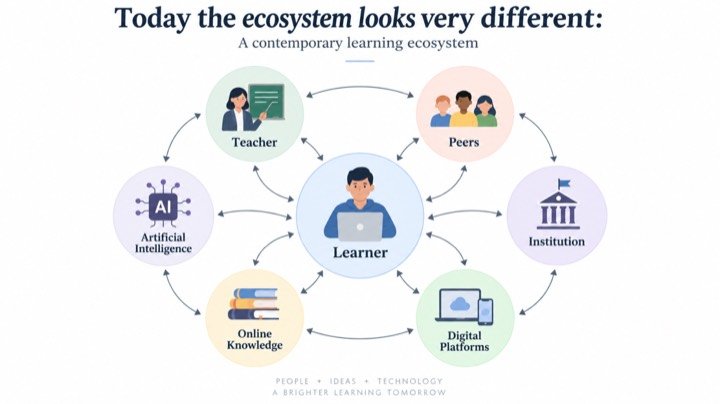
We live in a transformational society, where technology reshapes cultural values, social practices, and economic structures at an unprecedented pace. Generative AI is part of this transformation.
In such a society:
- Efficiency is Prioritized: Quick answers and productivity are rewarded, often at the cost of deep learning.
- Attention Spans Shrink: Constant access to AI accelerates a culture of immediacy, reducing patience for struggle.
- Cultural Intelligence Evolves: New forms of literacy (AI literacy, digital discernment) become as important as traditional reading and writing skills.
The danger is that students, as future citizens, may lack the resilient thinking skills necessary to navigate uncertainty, complexity, and ethical dilemmas. If AI handles all surface-level cognition, society risks producing graduates who are proficient consumers of information but weak in critical evaluation and innovation. For scholars and educators, the challenge is to reimagine pedagogy in a way that leverages AI while preserving the necessity of intellectual struggle. Some approaches include:
- Embedding metacognitive reflection: asking students to explain how they arrived at conclusions, not just present answers.
- Using AI as a sparring partner: encouraging critique, comparison, and modification of AI outputs.
- Designing assessments that test applications in novel contexts, making it harder for AI to provide one-size-fits-all answers.
In corporate environments, generative AI promises efficiency in report writing, coding, and decision-making. Yet the same risks apply: over-reliance on AI may reduce strategic thinking, judgment, and creativity.
Organizations should:
- Promote blended learning models that combine AI assistance with hands-on problem-solving.
- Encourage employees to challenge AI recommendations, developing a culture of critical inquiry.
- Integrate scenario-based learning where AI outputs must be evaluated against real-world constraints.
Such tactical initiatives would ensure that AI supports productivity without undermining the human capacity for innovation. For learners, the temptation to “copy-paste” from AI is strong. However, students must recognize that shortcuts today lead to weaknesses tomorrow. By avoiding the discomfort of struggle, they risk undermining their own intellectual independence.
It would be rather pragmatic to:
- Use AI as a guide, not a crutch.
- Practice retrieval learning (solving problems without help, then checking with AI afterwards).
- Build muscle memory by deliberately practising without technological aids before turning to AI tools.
The ultimate goal is not to reject AI, but to integrate it in ways that enhance human cognition rather than replace it. This requires:
- Ethical Instructional Design: embedding AI use in tasks that still require student reasoning.
- Policy Reform: developing academic integrity policies that balance innovation with fairness.
- Cultural Shifts: reframing the narrative so that struggle is not seen as inefficiency, but as a necessary path to mastery.
Muscle memory—both physical and cognitive—is the silent engine of expertise. It is cultivated through practice, struggle, and repetition. Generative AI, while transformative, risks short-circuiting this process by offering easy answers that inhibit the brain’s natural pathways of learning. From the perspectives of cognitive load theory, educational neuroscience, instructional design, and societal transformation, we see a clear paradox: AI makes knowledge accessible, but at the cost of weakening the very faculties that sustain deep thinking. For students, academicians, and corporate professionals, the challenge is to embrace AI without surrendering the intellectual resilience that only human struggle can build. The future belongs not to those who simply use AI, but to those who can think beyond it.