
Every year, 22she Shravan returns to Santiniketan not merely as a date on the Bengali calendar, but as a day of remembrance. It was on this day in 1348 Bangabda—7 August 1941—that Rabindranath Tagore passed away. Yet, in Santiniketan, death seems an inadequate word with which to remember him. The man departed; the questions he left behind did not.
For those of us who had the privilege of growing up, both literally and intellectually, in Santiniketan, Tagore was never confined to the pages of Gitanjali. He was present in the landscape itself—in the red earth beneath our feet, in classes held under trees, in the songs that marked the changing seasons, in the easy proximity between teachers and students, and in the idea that learning need not always announce itself as learning. As a student of Patha Bhavana and later Visva-Bharati, I understood many of these experiences simply as part of growing up. Their educational significance became clearer much later.
Perhaps that was Tagore’s greatest achievement as an educationist: he made education feel like life.
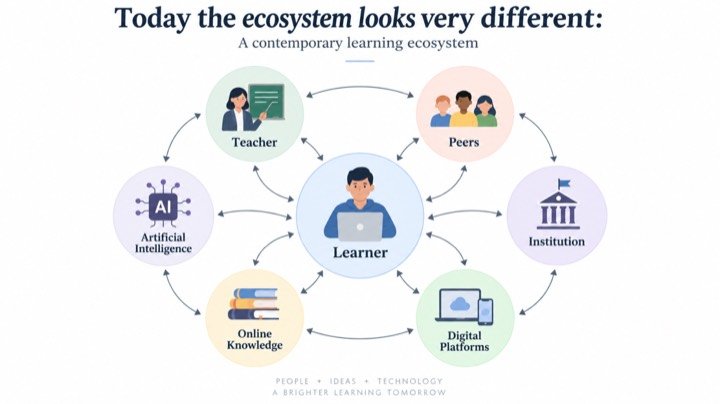
More than a century after he established his school at Santiniketan, education has changed beyond what Tagore could possibly have imagined. We now speak of artificial intelligence, virtual classrooms, learning analytics, global university rankings, digital credentials and technology-enabled personalised education. A student carrying a smartphone has access to more information than entire libraries could once contain.
Yet the fundamental anxieties of education remain surprisingly unchanged. Are our children becoming educated, or merely becoming efficient at examinations? Does schooling deepen curiosity or gradually domesticate it? Are universities creating independent minds or credentialled conformists? And now, when an intelligent machine can produce an essay, solve a problem or summarise a book within seconds, an even more fundamental question confronts us: what exactly should a human being learn?
Tagore seems remarkably contemporary because he began with precisely this larger question.
He had little affection for education that treated the child as a passive receptacle into which information was to be poured. His own unhappy encounters with formal schooling shaped his lifelong resistance to regimented learning. In Santiniketan, he attempted something radically different. The child, rather than the syllabus, was placed at the centre of education.
His famous lines from Gitanjali are usually read as a prayer for national and intellectual emancipation:
“Where the mind is without fear and the head is held high;
Where knowledge is free;
Where the world has not been broken up into fragments by narrow domestic walls;”
But they can equally be read as Tagore’s educational manifesto. A mind living in fear cannot truly inquire. A child perpetually anxious about making mistakes eventually discovers that silence is safer than curiosity. A student rewarded only for reproducing the expected answer learns to seek approval rather than truth.
Tagore wanted the mind to breathe.
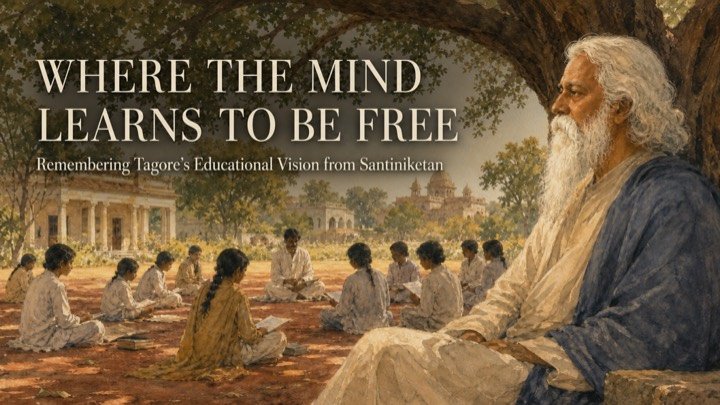
That is why the open-air classes of Santiniketan were far more than an architectural novelty. The tree was not merely a substitute for the classroom roof. It represented a different relationship between the learner and the world.
Nature, in Tagore’s philosophy, was not something to be studied only through chapters in a textbook. It was a living presence. Seasons changed visibly around the learner. Leaves appeared and disappeared. Birds, rain, dust, sunlight and the vastness of the sky formed part of one’s sensory education. Learning began with attention.
This idea has acquired an unexpected urgency in our digital age. We increasingly encounter the world through screens. A child can watch a high-definition documentary on forests without ever touching a tree’s bark. One may know the chemistry of soil without ever having held a handful of earth. Information about experience is slowly becoming a substitute for experience itself.
Tagore would have recognised the danger.
He believed education should connect rather than separate—human beings with nature, knowledge with experience, intellect with emotion and the individual with society. In Santiniketan, therefore, music, painting, dance, theatre, literature and physical activity were never regarded as decorative additions to serious” education. They were ways of knowing.
Long before the modern vocabulary of “holistic education”, “experiential learning”, “multidisciplinary education” and “arts integration” entered policy documents, Tagore was experimenting with their deeper possibilities.
The implications are even more significant today. Artificial intelligence is rapidly becoming capable of performing many tasks once regarded as evidence of intellectual accomplishment. It can retrieve facts, translate languages, generate text, produce images, and assist in solving complex problems. If education continues to value primarily the reproduction of information, machines will increasingly outperform us at the very game we have designed.
Tagore’s educational vision points elsewhere.
Education must cultivate what makes intelligence meaningful: imagination, judgement, curiosity, aesthetic sensitivity, empathy, and the ability to ask questions for which no predetermined answer exists. If machines increasingly help us answer questions, perhaps schools and universities must become better at teaching human beings which questions are worth asking.
There was another quiet revolution in Santiniketan—the relationship between teacher and learner. The teacher was not meant to remain an intimidating figure positioned at an authoritarian distance. Learning could occur through conversation, companionship and shared intellectual experience.
For those of us who studied at Patha Bhavana, this relationship was often experienced in ordinary ways. Teachers were accessible. Conversations did not necessarily end when a formal class ended. The boundary between academic learning and the rest of life could be pleasantly porous.
Tagore did not diminish the teacher’s role; he made it more demanding. A teacher was not simply expected to transmit knowledge, but to awaken another mind.
Modern pedagogy gives this many names—mentoring, facilitation, dialogic learning, learner-centred education. Tagore understood its human essence much earlier: education is fundamentally relational.
Yet his educational imagination did not stop with the child or the school. With Visva-Bharati, Tagore attempted something more ambitious. He wanted to create a meeting place of civilisations.
Its Upanishadic motto, Yatra visvam bhavatyekanidam—where the whole world meets in a single nest—expressed his extraordinary conception of a university.
Today, universities speak enthusiastically about internationalisation. We measure foreign collaborations, international students, exchange programmes and global rankings. Tagore’s internationalism was different. He wanted cultures to encounter one another intellectually and humanly.
He wanted India to meet the world without ceasing to be India.
This distinction is essential. Tagore’s cosmopolitanism did not entail cultural homelessness. He was deeply immersed in India’s philosophical and literary traditions, particularly the Upanishads, yet remained intellectually hospitable to other civilisations. Santiniketan welcomed scholars, artists and thinkers from across the world. China, Japan and other Asian civilisations were not distant curiosities but participants in a conversation. Western scholarship was welcomed without accepting the proposition that modernity required imitating the West.
Tagore’s world citizen was therefore neither rootless nor insular. He was rooted enough to be open.
That idea has immense value in an age when young people inhabit multiple identities simultaneously—local, linguistic, regional, national and global. Education should not force them to choose between cultural belonging and global citizenship. It should give them the confidence to embrace both.
Tagore’s unease with aggressive nationalism stemmed from the same humanism. He loved India too deeply to imagine her greatness through hostility towards others. In his lectures collected as Nationalism, he warned against the nation’s transformation into a mechanical organisation of power.
His educational response was not withdrawal from the world but deeper engagement with it. Education had to prepare human beings who could love their own culture without fearing another person’s culture.
In a fractured contemporary world, this may be among Tagore’s most important lessons.
There was, however, another dimension to his education that modern institutions sometimes overlook: the education of sensibility.
We are exceptionally good at measuring what students know. We assign marks, credits, grades and ranks. Universities count publications, citations and placements. These measures have their purpose. But there is no examination for wonder. No transcript records whether a student has become more compassionate. There is no convenient metric for the capacity to recognise beauty, respect difference or feel another person’s suffering.
Tagore considered these educational outcomes nonetheless.
This is why the seasons entered the educational calendar of Santiniketan. Music accompanied collective life. Festivals, drama, poetry and nature cultivated the senses as much as the intellect. Education was expected not simply to make a person clever, but to make a person more fully human.
Tagore captured this philosophy memorably when he wrote: “The highest education is that which does not merely give us information but makes our life in harmony with all existence.”
That distinction between information and education has perhaps never been more important.
We live amid unprecedented abundance of information. Search engines can locate it; algorithms can organise it; artificial intelligence can synthesise it. The emerging scarcity lies elsewhere—in sustained attention, independent judgement, empathy, wisdom and the ability to distinguish knowledge from noise.
Tagore’s education was also unwilling to accept the artificial separation of the mind from the hand. His experiments associated with Sriniketan brought education into conversation with agriculture, crafts, village industries and rural reconstruction. Knowledge had to participate in life.
Today, universities rediscover this idea through skill education, experiential learning, community engagement, social entrepreneurship and innovation. But Tagore’s philosophy carries an important caution: education should connect skills with dignity and purpose. Employability is important, but a human being is larger than an employee.
Perhaps nowhere is his criticism of mechanical education more sharply expressed than in Tota Kahini, or The Parrot’s Training. In Tagore’s satire, enormous effort is devoted to educating a bird. Elaborate arrangements are created, books accumulate, and authorities congratulate themselves on the sophistication of the process. Amid all this concern for education, the living bird is forgotten.
The machinery succeeds. The learner does not.
More than a century later, the parable remains painfully recognisable whenever syllabus completion matters more than curiosity, examination performance more than understanding, or institutional metrics more than the human being inside the institution.
Tagore’s warning is simple: never allow the system of education to become more important than the person being educated.
And this brings me back to Santiniketan.
Memory is strange. It preserves experiences long before we understand their significance. I remember the open spaces, the red khoai earth, the trees, songs and celebrations, and the particular informality with which learning entered everyday life. As children, we did not describe these things as educational philosophy. We simply lived them.
Only much later does one realise the audacity of the experiment.
Tagore was attempting to bring together what modern life repeatedly pulls apart: nature and civilisation, reason and imagination, art and science, hand and mind, teacher and learner, India and the world.
His model was never meant to become another rigid formula. To mechanically reproduce Santiniketan would perhaps be the most un-Tagorean thing we could do. What matters is the philosophy beneath it—the freedom to inquire, the courage to imagine, intimacy with nature, respect for cultural plurality, dignity of work and faith in the wholeness of human development.
On this 22she Shravan, therefore, I do not wish merely to remember Tagore as a figure belonging to history. I would rather allow him to question our present.
Can our schools still cultivate fearless minds? Can universities educate world citizens without uprooting them from their cultural heritage? Can technology expand human intelligence without encouraging us to abdicate it? Can we teach children to live with nature rather than merely learn about environmental sustainability? Can science converse with poetry? Can intelligence coexist with compassion? Can education prepare someone for a career without reducing the meaning of life to a career?
And, above all, can we preserve the child’s desire to ask “why”?
Tagore gave us no convenient checklist of answers. He gave us something far more valuable: an educational imagination.
For a former student of Patha Bhavana and Visva-Bharati, perhaps the most meaningful tribute to Gurudev on 22she Shravan is not merely to remember the school he created or to repeat the words he wrote. It is to carry Santiniketan within us—the courage to question, the freedom to imagine, the humility to learn from another culture, the sensitivity to listen to nature, and the wisdom to remain human in a world increasingly fascinated by intelligent machines.
More than a century later, we are still trying to build the education Tagore imagined.
And perhaps we need it now more than ever.
References and Sources
- Tagore, R. (1913). Gitanjali (Song Offerings). London: Macmillan. [Originally published in Bengali; English Gitanjali first published in 1912 by the India Society.]
- Tagore, R. (1917). Nationalism. London: Macmillan.
- Tagore, R. (1919). The Centre of Indian Culture. Madras: Theosophical Publishing House.
- Tagore, R. My School. In collections of Tagore’s writings and lectures on education.
- Tagore, R. Tota Kahini (The Parrot’s Training). A satirical story critiquing mechanical and authoritarian education.
- Tagore, R. (1922). Creative Unity. London: Macmillan.
- Tagore, R. (1929). The Religion of Man. Lectures subsequently published by George Allen & Unwin, 1931.
- O’Connell, K. M. (2002). Rabindranath Tagore: The Poet as Educator. Kolkata: Visva-Bharati.
- Visva-Bharati. Institutional history and writings concerning the founding ideals of Santiniketan and Visva-Bharati.