

The arrival of increasingly capable agentic AI systems, such as Fable 5, has reignited old questions and created new anxieties. As the boundary between weak and strong AI narrows, humanity faces profound questions about work, purpose, inequality and survival in a world where intelligence itself is becoming abundant.
The public unveiling of Anthropic’s Claude Fable 5 has once again reignited a debate humanity has periodically confronted whenever a disruptive technology emerges. Yet this time, the stakes appear considerably higher, given the unprecedented magnitude and pace of change. Systems that only a few years ago served as sophisticated assistants have evolved into autonomous agents capable of writing, debugging, and maintaining vast software ecosystems. Tasks that once required teams of engineers working for years are now being compressed into hours or days. The economics of knowledge work, coding, and decision-making are being recalibrated before our eyes.
To understand the anxiety surrounding such developments, it is important to distinguish between weak AI and strong AI, as researchers have traditionally defined them. Weak AI, or narrow AI, is designed for specific tasks. It may outperform humans in coding, chess, medical diagnostics or language generation, but it lacks genuine understanding, consciousness and self-awareness. It excels at recognising patterns and processing information at extraordinary speed. Today’s large language models, however impressive, still fall into this category.
Strong AI, on the other hand, refers to a hypothetical system with human-like general intelligence, capable of understanding, reasoning, contextualising, and perhaps even exhibiting autonomous agency comparable to or surpassing our own. Strong AI remains theoretical. Despite the excitement generated by frontier models, no evidence currently suggests that machines have crossed that threshold.
Yet the distinction offers little comfort to those watching the pace of progress. If weak AI can already perform tasks once considered uniquely human, what might increasingly powerful systems achieve? The release of Fable 5 itself reflects this dilemma. Anthropic has deliberately restricted access to some of its most advanced capabilities, limiting them to trusted organisations and governments owing to concerns about cybersecurity and biosecurity. Such restrictions reveal that even the companies building these systems are uncertain about the consequences of unrestricted deployment.
These concerns echo the warnings of Geoffrey Hinton, often referred to as the “Godfather of AI”. Hinton has repeatedly argued that the possibility of advanced artificial intelligence posing existential risks should not be dismissed lightly. His warnings are not predictions of inevitable doom but acknowledgements that humanity has never before attempted to control entities that may eventually surpass human intelligence. He has estimated a non-trivial probability that AI could threaten human survival over the coming decades, while simultaneously advocating greater investment in AI safety and governance.
Nevertheless, fears of an imminent machine uprising often obscure more immediate dangers. History suggests that technological revolutions rarely annihilate humanity; instead, they disrupt societies. The Industrial Revolution displaced artisans and created factories. Computers eliminated certain clerical jobs while giving rise to entirely new industries. Artificial intelligence may follow a similar pattern, though at a speed never witnessed before.
The more pressing concern may not be extermination but fragmentation. If machines increasingly perform coding, analysis, legal drafting, creative production, and even managerial decision-making, what happens to millions whose skills are suddenly rendered economically redundant? Geoffrey Hinton himself has warned that AI-driven productivity gains may disproportionately enrich a small elite while leaving large sections of society behind, unless governments intervene through new economic arrangements and social protections.
Early symptoms are already evident. Young programmers increasingly rely on AI-assisted workflows. Some use portable “cyberdecks” and agentic systems that automate tasks while evading institutional monitoring. Knowledge itself is becoming externalised. Instead of remembering, people retrieve. Instead of understanding, they prompt. Cognitive effort risks giving way to cognitive convenience.
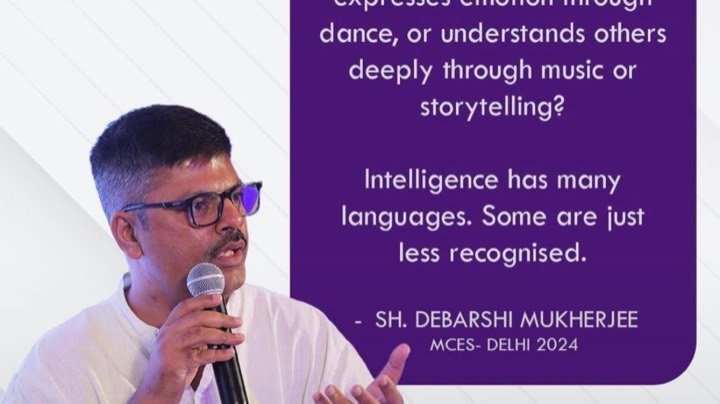
The situation as it stands raises a deeper philosophical question. If machines eventually perform not only physical labour but also intellectual labour, what remains uniquely human? The answer may not lie in competing with machines but in redefining human value. Creativity, ethical judgement, empathy, social intelligence, wisdom and meaning-making may become more important than mere information processing.
Yet the competitive race shows no signs of slowing. If one company develops a powerful model, rivals will inevitably seek to surpass it. Market incentives, geopolitical rivalry and national security concerns make a global pause highly unlikely. Even the creators of these technologies acknowledge that progress is outpacing regulatory institutions’ ability to adapt.
Perhaps the question is not whether artificial intelligence will destroy humanity. Civilisations rarely collapse because of technology alone. They fracture when institutions fail to adapt to technological change. The greatest danger may not be superintelligent machines, but human societies unable to manage inequality, unemployment, social alienation, and the concentration of unprecedented power in the hands of a few.
The future may therefore resemble neither a science-fiction apocalypse nor utopian abundance. It may instead become a prolonged struggle over how wealth, knowledge and human purpose are redistributed in an age when intelligence itself is increasingly abundant.
The machines are not becoming human. The more pressing question is whether humans, in their pursuit of efficiency and convenience, risk losing sight of what it means to be human.
And perhaps that is the unsettling possibility that should concern us most. Let’s ruminate a bit.
The astonishing capabilities demonstrated by Anthropic’s Fable 5 have also given rise to an entirely new culture among technologically inclined youth. One of the more intriguing developments is the emergence of the so-called “cyberdeck” ecosystem. Borrowed from cyberpunk imagination, cyberdecks are portable, customised computing rigs that integrate open-source tools, AI agents, local language models, networking devices and compact hardware into highly autonomous workstations. For many enthusiasts, these machines represent digital self-reliance and creative experimentation. Yet they also raise uncomfortable questions. Their ability to operate independently, sometimes outside conventional monitoring systems, has generated concerns among governments and security agencies. To some, cyberdecks symbolise technological freedom; to others, they exemplify how rapidly advanced capabilities are decentralising and becoming increasingly difficult to regulate.
Stories from Fable 5’s early deployment illustrate why so many experts believe we are entering a fundamentally different phase of artificial intelligence. Engineers have reported that tasks once split among dozens of software developers are increasingly handled by a handful of specialists overseeing AI agents. A large software architecture that once required years of coordination and countless human hours can now be designed, tested and refined in remarkably compressed timeframes. What once demanded extensive meetings, documentation and debugging cycles has become an iterative dialogue between humans and machines. In several cases, organisations have found themselves rethinking not only coding practices but also the very structure of project management and decision-making.
The implications extend far beyond software engineering. If intelligent agents can write code, analyse contracts, generate reports, conduct research, prepare legal drafts, design advertising campaigns, and manage customer interactions, disruption will not be confined to a single profession. Junior programmers, paralegals, market analysts, content writers, call centre executives, and even middle managers may find themselves competing with systems that operate continuously without fatigue. Some observers compare this moment to the arrival of electricity or the internet. Yet unlike previous revolutions, artificial intelligence threatens to automate cognitive labour itself.
The question naturally follows: where will these people go? History suggests that societies eventually create new forms of work, but it offers little reassurance about the transition. Millions displaced from traditional occupations cannot all become AI engineers. Many may migrate towards roles requiring emotional intelligence, interpersonal trust, caregiving, education, entrepreneurship, community building and creative expression. Others may become supervisors of autonomous systems rather than direct producers. Entirely new professions, unimaginable today, may emerge, just as social media managers and app developers did in the previous technological wave. Yet there is no guarantee that the number of new opportunities will match the number of occupations rendered obsolete.
One anecdote often recounted during the Industrial Revolution concerned textile workers who feared that mechanical looms would destroy civilisation. The world did not end, but generations endured hardship before new industries absorbed displaced labour. The present transition may prove even more profound because the machine is no longer merely replacing muscle; it is beginning to imitate reasoning itself. The concern, therefore, is not simply unemployment but the possibility of a widespread loss of purpose. Human beings derive dignity not merely from income but from feeling useful.
This explains why Geoffrey Hinton’s warnings have resonated so deeply. His concerns go beyond a Hollywood-style robot rebellion. Rather, he worries about a world where intelligence becomes cheap and abundant, while meaning, social cohesion and economic opportunity grow scarce. The danger may not come from machines deciding to exterminate humanity, but from societies gradually fracturing under unprecedented inequality and concentrations of power.
The rise of agentic AI further complicates matters. Unlike earlier systems that merely responded to commands, agentic systems can plan, execute sequences of actions, and coordinate with other agents with minimal supervision. In effect, organisations are beginning to experiment with digital employees. One can easily imagine a future office where a human executive oversees hundreds of specialised AI agents handling finance, legal affairs, marketing, software development, and strategic analysis. Such a scenario would have seemed implausible only a few years ago.
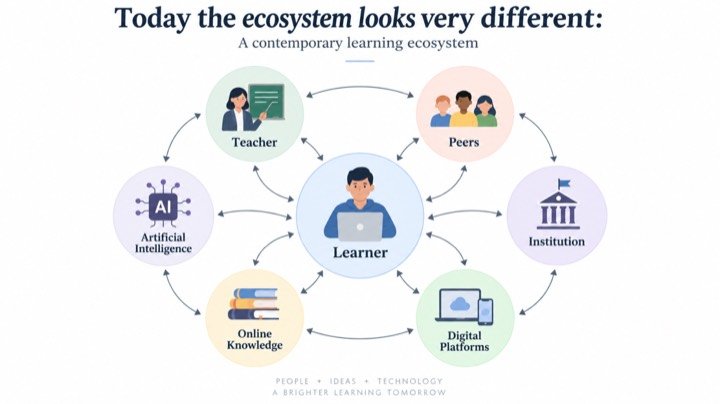
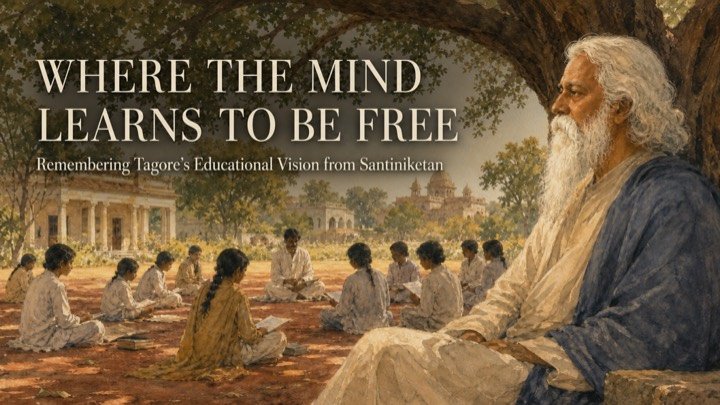
How, then, do we survive this progression? Survival may depend less on competing with machines and more on cultivating qualities machines cannot easily replicate. Critical thinking, ethical judgement, social intelligence, adaptability, creativity, resilience and the ability to collaborate with intelligent systems may become more valuable than memorising information or performing routine tasks. Educational institutions may need to abandon nineteenth-century models designed for industrial economies and embrace AI literacy, lifelong learning and interdisciplinary thinking.
Should humanity celebrate or raise a red flag? The answer perhaps lies between uncritical optimism and paralysing fear. To celebrate blindly would be irresponsible, and to panic would be equally misguided. Nuclear energy can illuminate cities or destroy them; biotechnology can cure diseases or create new threats. Artificial intelligence is also a dual-use technology. It demands stewardship rather than worship.
Perhaps the greatest irony of our age is that while we are investing enormous resources to make machines more intelligent, we are investing comparatively little in understanding what makes human life meaningful. If Fable 5 and its successors eventually perform much of what we presently call work, the central question of the twenty-first century may no longer be how humans earn a living but how they define a life worth living.
The race towards ever more capable systems will almost certainly continue. Competitors will build models beyond Fable 5. Governments will seek a strategic advantage. Markets will reward efficiency. The real contest, however, may not be between humans and machines. It may be between wisdom and speed, between social cohesion and technological acceleration, and between a civilisation that merely invents powerful tools and one that learns to live with them.
For the first time in history, humanity is not only creating machines that extend its strength but also machines that may eventually rival its intellect. Whether that story becomes one of flourishing or fragmentation will depend less on artificial intelligence itself and far more on human intelligence, political wisdom and moral imagination.