

As artificial intelligence reshapes society, education faces a clear challenge: preparing students not just to use technology, but to think systematically, critically, and imaginatively. Computational thinking offers a philosophy of learning that goes beyond coding and helps teachers and learners across disciplines develop the habits of mind needed for an AI-shaped future.
Opening Thoughts
Artificial intelligence is altering almost every aspect of modern life. From healthcare and banking to education and governance, intelligent systems now influence decisions that once relied almost entirely on human judgment. In this context, governments around the world, including India, have placed increasing emphasis on computational thinking. To many observers, this emphasis may seem synonymous with coding or computer science. In truth, it points to something deeper: the need to prepare people who can understand problems, organise information, recognise patterns, and reason well.
For a long time, literacy and numeracy were regarded as the foundations of citizenship and economic participation. In the industrial age, these abilities enabled people to contribute meaningfully to social and productive life. In the twenty-first century, a third literacy is becoming equally important. Computational thinking is increasingly seen as a cognitive capability for navigating complexity, uncertainty, and intelligent machines.
This is why educational reforms, including India’s New Education Policy 2020, emphasise coding, artificial intelligence, problem-solving, and digital literacy. The aim is not to produce millions of software engineers. The broader purpose is to cultivate citizens who can examine problems carefully, interpret information, test assumptions, and make reasoned decisions. A nation that only consumes technologies developed elsewhere risks dependence on innovation, productivity, and strategic security.
What Computational Thinking Means
Computational thinking is not primarily a technological skill. It is a disciplined way of approaching problems. It includes decomposition, in which complex issues are broken into manageable parts; pattern recognition, which identifies similarities and relationships; abstraction, which separates essential information from distracting detail; and algorithmic thinking, which builds logical sequences for solving problems.
These abilities are not confined to computer scientists. A doctor diagnosing disease, a historian interpreting events, a lawyer building an argument, a farmer optimising resources, and an entrepreneur identifying opportunity all use forms of computational reasoning. They may not write code, but they analyse systems, compare evidence, recognise patterns, and decide what should happen next.
Theoretical Foundations
The importance of computational thinking becomes clearer when it is viewed through established theories of learning and cognition. Seymour Papert’s theory of constructionism provides one strong foundation. Building on Jean Piaget’s constructivism, Papert argued that learners understand concepts more deeply when they actively construct knowledge instead of passively receiving information. Computational thinking reflects this view because it encourages experimentation, modelling, testing, and revision.
Piaget maintained that cognitive development occurs through assimilation and accommodation, as learners reorganise their understanding in response to new experiences. Computational thinking supports this kind of intellectual restructuring. Students do not simply memorise facts; they learn to arrange knowledge, revise explanations, and adapt their reasoning.
Lev Vygotsky’s sociocultural theory adds another important dimension. Learning is social: knowledge develops through interaction, collaboration, and guided support within the learner’s zone of proximal development. Computational thinking is, therefore, not an isolated activity. Students learn by discussing ideas, testing alternatives, comparing solutions, and refining their thinking together. In such a classroom, the teacher becomes a facilitator of reasoning rather than a transmitter of answers.
Jerome Bruner’s theory of discovery learning also aligns with this approach. Bruner believed that education should help learners discover underlying structures and principles. Computational thinking asks students to look beyond surface facts to uncover relationships, patterns, causes, and consequences.
Herbert Simon’s theory of bounded rationality from cognitive psychology offers another explanation. Simon argued that human beings make decisions under constraints of time, information, and mental capacity. They therefore need heuristics and structured methods to decide effectively. Computational thinking serves this purpose by helping learners simplify complexity and manage information overload, two features that define the digital age.
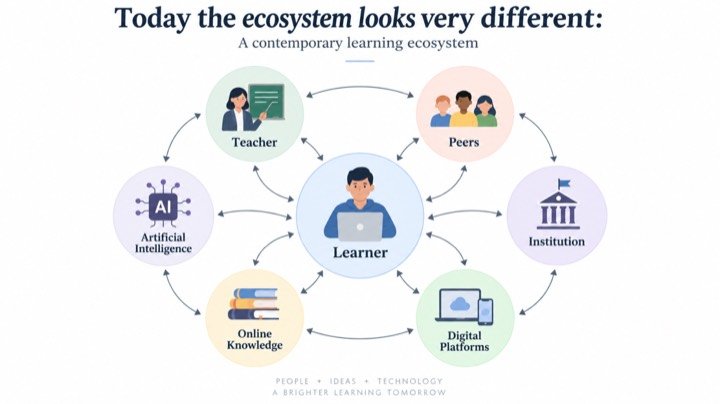
Connectivist theorists such as George Siemens and Stephen Downes view learning as the ability to navigate information networks distributed across people and technologies. In a world where AI systems and digital platforms shape access to knowledge, computational thinking equips learners to engage with these networks intelligently rather than be overwhelmed by them.
At a broader social level, Gary Becker’s Human Capital Theory reminds us that investment in knowledge and skills contributes to national development. In the age of AI, computational thinking can be seen as a form of cognitive capital. Countries that cultivate it are more likely to foster innovation, technological independence, and economic resilience.
Across the Curriculum
One of the common misunderstandings about computational thinking is that it belongs only to computer science. In practice, it can be embedded across disciplines.
In biology, students often memorise the heart’s anatomy, the stages of mitosis, or Mendelian ratios. A computational approach helps them understand systems and relationships. They might examine blood circulation as a transportation network, map what happens when an artery is blocked, or create flowcharts showing how oxygen moves through the body. In genetics, they can model inheritance patterns, identify recurring structures, and simulate possible outcomes. Biology then becomes a study of connected processes rather than a collection of isolated facts..
English literature offers equally rich possibilities. At first glance, literature and computation may seem unrelated. Yet literary analysis often involves identifying recurring motifs, tracing patterns of conflict, understanding relationships among characters, and constructing coherent interpretations. A teacher discussing Shakespeare’s Macbeth might ask students to examine the sequence of decisions that leads to Macbeth’s downfall. They might describe the tragedy as a flawed sequence of ambition, fear, guilt, and consequence. Essay writing also draws on algorithmic reasoning: ideas must move logically from introduction to argument, evidence, analysis, and conclusion. Good writing is organised thinking.
Chemistry also lends itself naturally to computational thinking. Chemical reactions are transformations governed by predictable relationships. Rather than memorising procedures, which induces rote learning, students can identify inputs, observe changes, predict outputs, and troubleshoot anomalies. Balancing chemical equations and studying periodic trends become exercises in pattern recognition and logical reasoning rather than mechanical recall.
These examples show that computational thinking is not about teaching every child to code. It is about teaching every child to think with clarity. B.F. Skinner’s idea of learning through reinforcement corroborates this productive struggle, which in turn strengthens muscle memory.
The Teacher’s Changing Role
For generations, education was organised around the transmission of information. That model is increasingly inadequate because information is no longer scarce. AI systems can now provide summaries, explanations, translations, and answers almost instantly. What remains scarce is careful inquiry, sound judgement, and the courage to question weak reasoning.
Teachers therefore need to shift attention from answers to reasoning. Instead of asking only, “What is the correct answer?”, they need to ask, “How did you arrive at that answer?”, “Can the problem be broken down into smaller parts?”, “What assumptions underlie your reasoning?”, and “Could there be another solution?” Such questions transform classrooms from places of memorisation into spaces of intellectual exploration.
The Apollo programme illustrates the point vividly. In the 1960s, NASA engineers faced the task of sending humans to the Moon with computers far less powerful than today’s smartphones. The mission succeeded not because the machines were powerful, but because human beings could break a vast challenge into smaller problems, test each part, coordinate knowledge, and correct errors. The achievement was technological, but it was also cognitive.
A simpler story makes the same point. A village repeatedly suffered floods. Each year, people rescued victims and rebuilt homes. One day, a young engineer asked why the village kept reacting to disasters instead of studying their causes. By examining rainfall patterns, mapping the terrain, and redesigning drainage, the community reduced the damage. The change did not come from stronger boats; it came from better thinking.
AI and Computational Thinking
AI and computational thinking are related but not the same. Artificial intelligence refers to machines that perform tasks associated with human intelligence. Computational thinking is the human capacity to organise thought systematically. The rise of AI makes computational thinking more important, not less.
Without this capacity, students may become passive consumers of machine-generated answers. They may accept outputs without asking whether the data are reliable, the assumptions are fair, the reasoning is sound, or the conclusion is ethical. The potential risk is not limited to machines thinking for us. The deeper risk is that we may stop practising the habits of thought that make us free, responsible, and creative.
Many education systems still reward rote memorisation, single correct answers, examination performance, content coverage, and passive consumption. Yet contemporary life demands critical thinking, problem-solving, creativity, collaboration, data literacy, ethical judgment, and adaptability. This creates a growing mismatch between what schools often reward and what the world now requires.
Albert Einstein’s observation that education is not the learning of facts but the training of the mind to think feels especially relevant today.
Why Society Benefits
The benefits of computational thinking extend beyond individual achievement. Societies composed of computational thinkers are more likely to foster strong research ecosystems, innovative industries, better governance, improved cybersecurity, and higher productivity. Such citizens are better equipped to evaluate information critically, resist misinformation, and participate responsibly in democratic life.
They become doctors who detect disease patterns, entrepreneurs who recognise opportunities, farmers who optimise resources, scientists who model climate systems, and citizens who question manipulation and bias. In this sense, computational thinking strengthens both democracy and the economy.
A country’s future prosperity depends not only on technological infrastructure but also on cognitive infrastructure. AI may automate tasks, but nations are built by people who can ask better questions, recognise patterns, exercise judgement, and solve complex problems.
Parting Thoughts
The critical challenge in education is not to teach children to compete with AI, but to teach them to think alongside it. For India, this challenge must now be a clear policy priority. Schools, colleges, teacher education institutions, and innovation bodies should actively foster computational thinking through curriculum design, problem-based learning, research competitions, student innovation grants, incubation support, and stronger links among classrooms, laboratories, industry, and local communities.
India needs to incentivise this way of thinking from the earliest stages of education. Students should be rewarded not only for reproducing answers but also for framing problems, testing ideas, building models, designing prototypes, and converting knowledge into useful solutions. Such encouragement can expand the country’s intellectual capital, increase the creation of marketable products and services, and strengthen self-reliance in critical technologies.
Computational thinking is, therefore, more than a technical skill. It is a national capability. If India cultivates young minds capable of asking better questions, recognising patterns, reasoning ethically, and turning ideas into practical innovations, it will not merely adapt to the age of AI; it will help shape it.