


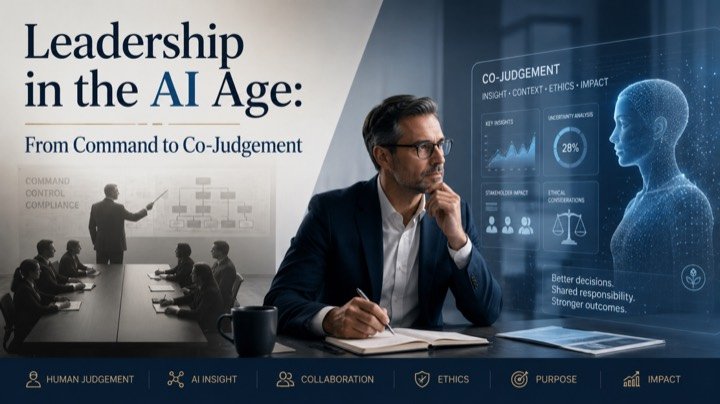
As AI moves from the back office to the boardroom, the best leaders will not be those who command machines, but those who know when to question them. This article argues that future leadership depends on co-judgement: combining AI’s analytical speed with human ethics, context, accountability and courage to challenge decisions before efficiency becomes institutional harm.
Artificial intelligence is no longer merely a technical upgrade. It is becoming part of how organisations notice, decide, reward, discipline and imagine the future. Machines can search vast datasets, identify patterns, produce forecasts and recommend action at speeds no traditional management routine can match. But prediction is not judgement. A forecast can say what is likely. It cannot say what is legitimate, humane, strategically wise or socially defensible. That is why the next great leadership capability will be co-judgement: the disciplined partnership between machine analysis and human responsibility.
The point is not that AI should be kept out of leadership. That would be both unrealistic and wasteful. The World Economic Forum’s Future of Jobs Report 2025 says that technological change, economic uncertainty, demographic shifts, geopolitical fragmentation and the green transition will jointly reshape labour markets by 2030. McKinsey’s 2025 global survey found that 88 per cent of respondents already report regular AI use in at least one business function, while most organisations are still struggling to scale AI sufficiently to capture enterprise-level value. The world is not waiting for leaders to become comfortable. It is already reorganising around tools that can analyse faster than institutions can deliberate.
Yet the same evidence points to an uncomfortable truth. The organisations gaining most from AI are not simply plugging it into old hierarchies. McKinsey reports that high performers are redesigning workflows, not merely buying software. PwC’s 2026 AI Jobs Barometer, based on more than a billion job advertisements, argues that AI is creating a two-track labour market in which judgement, leadership, empathy and creativity become more valuable as routine work is absorbed by machines. The most AI-exposed junior roles are now far more likely to demand skills once expected of senior people. In plain language, the machine may take away some drudgery, but it also removes the long apprenticeship through which many people learned judgement.
This is a profound challenge for companies and universities. For decades, organisations trained future leaders by guiding them through information gathering, analysis, supervision and decision-making. AI compresses that ladder. A young analyst may no longer spend years preparing first drafts, checking data and learning from low-risk mistakes. Instead, they may be handed an AI-generated recommendation and asked to evaluate it. That looks efficient, but it can be dangerous if people have not developed the muscles of doubt, context and moral reasoning. A generation may be promoted from prompt-writing to decision-making without ever learning how decisions acquire legitimacy.
Co-judgement offers a better framework. It recognises that AI excels at speed, scale, memory, pattern recognition and consistency. It also recognises that human beings remain responsible for purpose, meaning, contestability and consequence. The leader’s job is therefore shifting from issuing commands to governing the conditions under which decisions are made. Leaders must ask: what data trained this system, whose experience is missing, what assumptions are hidden, who can challenge the output, and who remains accountable when the recommendation harms someone?
Consider recruitment. An AI tool can screen thousands of applications and detect correlations between candidate profiles and past employee performance. Used carefully, it may reduce administrative burden and widen the pool. Used carelessly, it may reproduce the past under the respectable guise of efficiency. If previous hiring favoured certain universities, accents, neighbourhoods or career paths, the model may learn those preferences and call them merit. A co-judgement leader would not ask only whether the system is accurate. They would ask accurately for whom, fairly by what standard, and appealable through which process.
The same applies to performance management. In a logistics company, a dashboard might flag drivers whose delivery times lag the median. A command-and-control leader may treat that signal as proof. A co-judgement leader asks whether traffic, vehicle condition, route design, customer behaviour or safety choices explain the variation. The difference matters. In one version, AI becomes a digital supervisor that tightens pressure and narrows trust. In the other, it becomes a diagnostic instrument that helps improve the system of work.
A hospital administrator recently described a familiar new ritual. Before the weekly review meeting, an AI system prepared the figures, ranked the pressure points, flagged likely staff shortages and suggested where resources should move next. The dashboard was fast, confident and, in many respects, useful. Yet the most important moment in the room came when a senior nurse asked a simple question: What is the model not seeing? It had registered bed occupancy and discharge delays. It had not registered the exhausted junior doctor quietly covering two teams, the family waiting for an explanation, or the ward culture that made people reluctant to challenge a target. That question captures the leadership problem of our time. Readers would certainly corroborate these gaps during the COVID-19 pandemic. Healthcare workers were overworked and fatigued, and it was a nightmarish situation for administrators to handle, which grew more aggravating with each passing day during the first and second waves.
This is why leadership in the AI age is not becoming less human. It is becoming more accountable to human values. The OECD’s AI principles emphasise human-centred values, transparency, explainability, robustness, safety and accountability. These are not abstract slogans. They are practical leadership duties. Workers should know when AI is involved in decisions about them. Customers should be able to understand consequential automated outcomes. Boards should know which systems are high risk, who owns them, how they are audited, and when they must be switched off.
The future will make this harder, not easier. AI agents are beginning to plan and execute multi-step tasks, not just answer questions. Supply chains are vulnerable to climate shocks and political fragmentation. Cybersecurity risks are rising. Workforces are ageing in some countries and expanding rapidly in others. Public trust in institutions is fragile. In such a world, leadership cannot mean heroic certainty from the top. It must mean organised judgement: the ability to bring together technical experts, frontline workers, ethicists, customers, regulators and communities into the decision architecture before failure becomes a scandal.
Companies should begin with three practical shifts. First, boards must treat AI governance as a leadership issue, not an IT appendix. Every high-impact AI system should have an accountable owner, a risk register, audit trails, clear escalation routes, and a defined point at which human review is mandatory. Secondly, organisations should classify decisions by reversibility and moral weight. A stock-replenishment recommendation is not the same as a redundancy, a loan rejection, a medical triage decision, or a disciplinary action. The greater the human consequence, the stronger the requirement for explanation, appeal, and human deliberation.
Thirdly, firms must redesign learning. The old leadership pipeline assumed that experience would accumulate slowly. That assumption is breaking down. Junior employees need structured exposure to ambiguity, ethical trade-offs, stakeholder conversations and post-decision reviews. They should be taught not only how to use AI but also how to disagree with it. Middle managers, often squeezed between executive ambition and employee anxiety, should be trained as AI translators: people who can explain what a model suggests, what it cannot know and how a team should respond.
Academia has an equally important role. Business schools and universities should stop treating AI as a specialist elective on the periphery of the curriculum. Students in commerce, management, law, medicine, public policy and the humanities need AI literacy, paired with ethics, behavioural science and systems thinking. Case teaching should address algorithmic bias, automation complacency, workplace surveillance, vendor dependence and the politics of data. Assessment should reward the ability to frame better questions, not merely to produce faster answers. A student who can responsibly challenge a model may be more valuable than one who can operate it fluently but passively.
There is also a cultural lesson. Many leadership failures occur not because people lack information, but because they lack permission to question the dominant interpretation. AI can intensify that danger because its outputs often carry the aura of objectivity. A number on a dashboard can silence a room. Co-judgement requires leaders to create rituals of challenge: red teams, dissent channels, model reviews, employee voice forums, and after-action learning. The best organisations will not be those where every AI output is obeyed quickly. They will be those where important outputs are examined intelligently.
This is not anti-technology. It is pro-responsibility. AI can help companies detect weak signals, reduce waste, personalise services, improve safety and open new sources of value. It can support climate adaptation, healthcare access, financial inclusion and better public services. But these gains will not arrive automatically. They depend on leaders who understand that efficiency without legitimacy is brittle, and that scale without accountability can multiply harm.
The leadership question of the next decade is therefore not whether humans or machines will decide. In serious organisations, both will shape the decision. The real question is who governs their relationship. A leader who only accepts the machine’s answer has abdicated. A leader who rejects the machine out of pride has also failed. The necessary figure is more demanding: a leader who can use AI for evidence, convene people for meaning, pause for judgement and stand publicly behind the consequences.
The age of command is giving way to the age of co-judgement. Organisations that understand the covenants of this evolving relationship between the leader and the team will move faster without becoming reckless, automate without dehumanising, and innovate without losing sight of why innovation matters. Those that do not may discover, too late, that the most dangerous decision is not the one made by a machine. It is the human decision to stop judging.
Before I conclude, there’s something that intrigues me. As AI becomes part of everyday decision-making, leadership is no longer only about choosing the right answer. It is also about knowing when to pause, question the evidence, protect human dignity and remain accountable for the consequences. Therefore, I leave a question for you to seek an answer: “When machines can recommend faster than humans can reflect, what kind of judgement must leaders preserve to ensure that progress remains ethical, inclusive and humane?”
Source note
World Economic Forum, The Future of Jobs Report 2025, published 7 January 2025. McKinsey & Company, The state of AI in 2025: Agents, innovation, and transformation, published 5 November 2025. PwC, 2026 AI Global Jobs Barometer: Two futures for jobs in an AI era, published 15 June 2026. OECD, AI Principles, including human-centred values, transparency, robustness and accountability. Original academic article supplied by the author: From Command to Co-Judgement: Reframing Corporate Leadership in the Age of Artificial Intelligence.